Celebrate National Night Out in Colorado

Celebrate the 28th Annual National Night Out in Colorado and throughout the country on Tuesday evening, August 2. National Night Out has been billed as America’s Night Out Against Crime. The NNO 2011 Campaign involves citizens, law enforcement agencies, civic groups, and business and neighborhood organizations from over 15,000 communities in all 50 states, U.S. territories, Canadian cities and U.S. military bases worldwide.

The goals of the National Night Out are to:

  • heighten crime- and drug-prevention awareness
  • generate support for local anticrime programs
  • strengthen neighborhood spirit and police communication partnerships

Solidarity and support of NNO is commonly shown by the traditional display of outdoor lighting including front porch lights, landscape/architectural lighting and through the participation in front porch vigils and neighborhood get-togethers.

Landscape Lighting Makes This Home Safer and More Secure

As the owner of a lighting company, I’ve been trained and well-versed in the art of illumination to remove “dark and scary” spaces around the perimeter of a home and property. Local law enforcement repeatedly advises homeowners that lighting is a key component of crime prevention. The City of Golden’s Police Department states that:

it is a recognized fact that good lighting is a deterrant to crime. It not only makes the area safer for the homeowner, but also forces the intruder to work in an area where he may be exposed and reported to the police.

To participate in one of this year’s NNO 2011 events, please check one of the links below:

COUNTIES:     Arapahoe, Boulder, Broomfield, Denver, Douglas, El PasoJefferson, Larimer

CITIES/TOWNS:  Aurora, Colorado Springs, Denver, Golden, Lakewood, Littleton, Lone Tree, Longmont, Parker, Sheridan, Westminster

Thanks in advance for your participation and for helping to make our communities safer.

Why Did My Landscape Lighting System Stop Working?

During the past week, Colorado has been subjected to a daily occurrence of severe thunderstorm activity with heavy rains and extensive lightning. It is not at all unusual for us to start receiving calls from customers asking why their landscape lighting systems have stopped working.

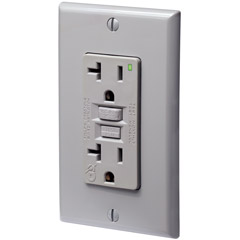
GFCI Outlet

If all of the landscape lights in a system stop working, typically there is a problem with the power to the low voltage lighting transformer. And 90-percent of the time the loss of power is due to a tripped Ground Fault Circuit Interrupter or GFCI. In some circles, some electricians and homeowners will also refer to these outlets as just a GFI. During stormy weather with heavy moisture and power surges created by lightning strikes/outages – GFCIs can sometimes trip due to their sensitivity.

That sensitivity of GFCIs is actually a good thing because it protects people from possible electrocution. When a hand tool or appliance is in use, the GFCI monitors the amount of current flowing from the hot to the neutral. If there is any imbalance in the current (as little as 4 or 5 milliamps), the GFCI can trip in as quickly as one-thirtieth of a second. If a person is standing outside on the ground and using an electric circular saw while it is raining, the saw is wet and a path is created from the hot wire through that person to the ground. If all of the current is diverted through the person, that could be fatal. That is why the National Electrical Code (NEC) requires the installation of GFCI outlets in new construction for electrical circuits in bathrooms, laundry rooms, kitchens, garages and on home exteriors. Older homes may only have one or two GFCI outlets (typically in bathrooms) to protect the circuits in the garage, kitchen and exterior.

So if your lights are not working, first check the outlet where your low voltage lighting transformer is plugged in. Plug in a radio or small appliance to see if you have power there. If there is no power, find and try to reset the GFCI. If the outlet where the transformer is plugged in does not have the GFCI test and reset buttons, you will need to find it. Remember that the actual GFCI for the circuit could be located in the garage, bathroom, laundry room, or on another outlet on the exterior of the house.

Once you have located the GFCI, push the reset button – and recheck the outlet by the transformer to ensure that the power has been restored. If there is still no power, you will have to keep looking for the GFCI that controls the circuit for the lighting. In newer houses, some garages may have as many as four or five separate GFCIs to accommodate power tools and central vacuum systems.

If you have reset the GFCI and the power has been restored, your lighting system is good to go. However, if your lighting system is controlled by a mechanical timer, you will have to reset the current time on the timer to ensure proper operation. If your system is controlled by a digital timer with battery backup or with Outdoor Lighting Perspectives’ (OLP) Lighting Control Automation™, just restoring power to the transformer is all you will need to do.

In the event that you tried to reset the GFCI and it would not physically reset, you should check your electrical panel to see if a breaker tripped for that circuit. If a breaker has tripped, reset it and then try again to reset the GFCI outlet. During this process if you have any problems resetting either the breaker or the GFCI, it would be a good idea to call in an electrician. Electrical breakers and GFCIs can break down and malfunction over time. In fact, the more times that breakers and GFCIs trip, the more susceptible they are to tripping the next time.

In the beginning of this article, I mentioned that 90-percent of the time that landscape lighting systems stopoped working due to GFCI outlets tripping. The other 10-percent of the time can be attributed to the fact that someone unplugged the low voltage transformer and neglected to plug it back in or to a problem connected to the control system.

Control system problems occur frequently with the older technology – mechanical timers, photocells, and X10. Those control system issues have been solved with Lighting Control Automation – but you still have to ensure that the automatic/manual controller inside your house has power 24/7 for the system to operate properly.

So the next time you have an issue with your landscape lighting system, try these steps first before scheduling a service call. However, please feel free to call our office at any time if we can be of further assistance.

← Back

Thank you for your response. ✨

GE Lighting Revolution Tour Is Coming to Denver

The GE Lighting Revolution Tour  is coming to Denver (Auraria Campus) on Wednesday, July 6th, 2011. As part of a 45-city tour throughout the U.S. and Canada, GE is showcasing the latest in lighting technology including LED, Ceramic Metal Halide, linear fluorescent, and compact fluorescent bulbs.

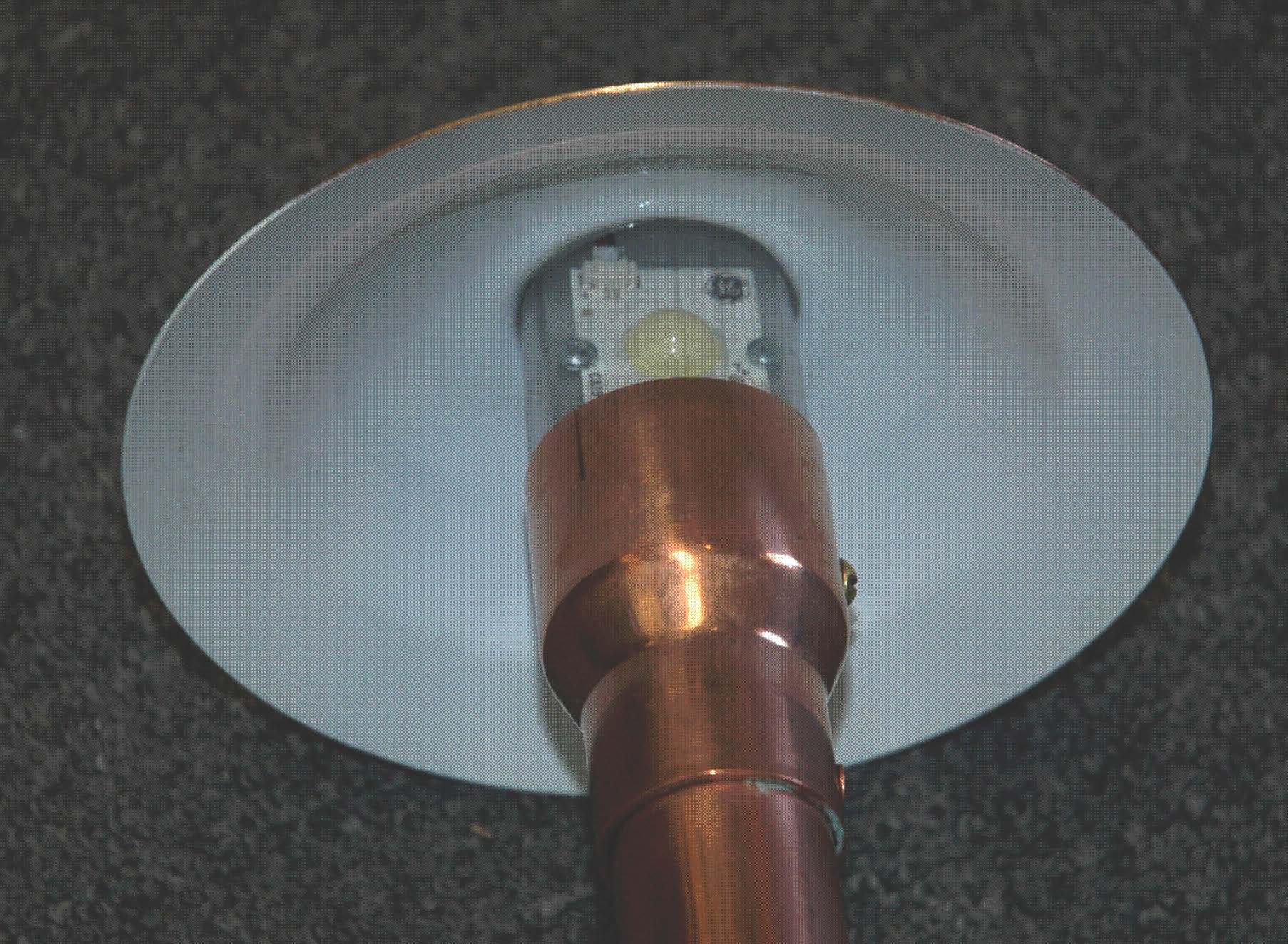
BB07 Path Light Powered by GE Vio LEDs

On display in the GE exhibit is their Vio LED technology that powers Outdoor Lighting Perspectives’ (OLP) copper path lights (BB07s and BB07.5s) as well as the BB04 flood lights and BB08 deck lights. OLP’s BB07 path light uses two of the Vio 3.6W LEDs – and by far it is the brightest and truest color path light available today. In fact, GE had some of these OLP fixtures on display at their exhibit at last May’s Light Fair in Philadelphia.

 
BB08 Deck Light Powered by GE Vio LED

The Vio LEDs are available with a (Color Rendering Index) CRI of 70 or 85 and at three different color temperatures (3000K, 3500K, and 4100K). The LEDs are rated to have a 70% lumen depreciation after 50,000 hours of operation – and are totally mercury free.

 
To see the truly amazing lighting effect with this new LED technology, plan to visit the GE exhibit when it comes to Denver or contact Outdoor Lighting Perspectives of Colorado for a complimentary evening lighting demonstration.
 

Can Landscape Lights and Mulch Coexist?


Mulch Covering Well LIght Causes Acrylic Lens Cover to Melt

During the spring months in Colorado, most homeowners start turning their attention to their outdoor living spaces, gardens, and lawns. A big part of this effort includes cleaning up any remaining leaves and other wind-blown debris from the property, and freshening up  the planting beds by re-mulching.


For those homeowners who also have landscape lighting systems installed on their property, it is critically important that none of the landscape fixtures become carelessly covered up by mulch during this process. If an outside landscaping contractor or handyman has been hired to do the re-mulching, it is encumbent on the homeowner to alert them to the location of each and every fixture – and instruct them not to cover up the fixtures. Many years ago one of our customers was out of town, and on a Friday afternoon, their landscaper carelessly dumped a 6-foot tall pile of mulch on one of the well lights. The landscapers didn’t plan to go back to the house until Monday to distribute the mulch – and early on that Saturday evening a girl riding her bicycle saw the resulting mulch fire. Fortunately, she summoned her father who was then able to douse the fire with a garden hose.

Our national company initially installed well lights without lens covers – and then quickly transitioned to the acrylic lens covers. For about the last four years, we’ve been using tempered glass lens covers on every well light that we install. The glass is thick enough that it prevents the outside of the lens from becoming as hot as the previous acrylic ones, and it keeps flammable materials from contacting the bulb directly. Surprisingly, most of the other major landscape lighting manufacturers are still not using lens covers of ANY kind. It’s not been uncommon when our crews are servicing non-OLP systems to find other manufacturer’s well lights that are totally covered by mulch. In some instances, we have found situations where a mulch fire had started previously.

OLP Well Light with Tempered Glass Lens Cover

As with everything else around the home, it does not take a lot of time to do some preventive maintenance to ensure that the lights are not being covered up by mulch, tumbleweeds, or leaves. Another rule of thumb is not to purchase the least expensive mulch (usually the lightest) that tends to blow away during the first good wind storm. In the early 2000’s, the National Electrical Code also addressed this issue by requiring that low voltage transformers have secondary circuit protection (the wiring that goes to the fixtures in the landscaping).

 
As lighting systems transition from quartz halogen to LED, mulch-related heat buildup problems and issues will decrease. However, in addition to safety, another main reason to ensure that your lighting fixtures are not covered up by mulch or dirt is because the light will be blocked – but you will still be paying the electric company for it anyway!
 

Can Line Voltage Lamp Posts be Converted to Low Voltage?

Retrofit Low Voltage Quartz Halogen Column Lights

In many of the older neighborhoods in Denver and along the front range, line voltage column lights or lamp posts had been used to illuminate the entrance walkway or driveway to a home. Over many years of time, this underground wiring has become corroded, frayed and/or cut – rendering the lighting fixtures inoperable.

One solution of course would be to trace and identify the defective wiring and either fix it or replace it completely. However, trenching and burying new line voltage wiring (18-inches deep in conduit or 24-inches deep for direct burial) can be very costly, not to mention the disruption and damage to the mature landscaping.

Fortunately, there is a much more cost effective solution for restoring power to these line voltage lamp posts and column lights – and that is by installing a low voltage transformer by the house – and running new low voltage wiring (6-inches deep) to the fixtures. The above photo shows an Outdoor Lighting Perspectives (OLP) installation along the 6th Avenue Parkway in Denver. In addition to not having any power to the columns, the existing fixtures were beyond repair as well. OLP installed two of its copper/brass BB-14 lanterns with 35W quartz halogen bulbs to replace the old fixtures. Not only did the homeowners save money by not having to replace the line voltage wiring, they will also be saving money over time by using more energy efficient bulbs.

LED vs. Incandescent Post Light Comparison

By using GE Vio LED technology, OLP can now provide a 50,000 hour lighting retrofit solution for new or existing lamp posts or column lights. In the photo, the fixture powered by GE Vio LED 7.2W total (left) is shown next to a regular 40W incandescent bulb. Fixtures having a frosted lens or globe work best as it allows for a better diffusion of the light.

 
So if you currently have any lamp posts or column lights that are having power issues, you may want to consider the less expensive option of retrofitting them to low voltage LED or quartz halogen – and saving additional money on your monthly electric bill.


Outdoor Lighting Perspectives of Colorado Is A Certified ReDirect Guide Green Business

Outdoor Lighting Perspectives of Colorado has been certified by and included in the online and print versions of the ReDirect Guide – the Denver/Boulder/Fort Collins regional guide to green businesses, resources, information and discounts. Each company selected for the Guide is personally screened by a ReDirect Guide staff person to ensure that its products and company practices are truly green. We’re certainly proud to offer our customers the latest in energy savings lighting (LED, induction fluorescent) as well as lighting energy audits.
You can pick up a print copy (on recycled paper) at these Colorado front range locations. The Guide contains a wealth of information on green products and services for your home and business, as well as upcoming environmentally conscious community events. In addition, the directory also contains a section of educational articles – and OLP of Colorado was proud to have sponsored the article on LED Outdoor Lighting that can be found on page 85.

OLP of Colorado is listed under two categories in the GuideEnergy Audits on page 168 and Landscape Contractors on page 203. We’re truly proud to be a part of this Colorado green directory – the longest running certified sustainable business network in Colorado.

Is It Too Late to Add Deck Lighting to an Already-Built Deck?

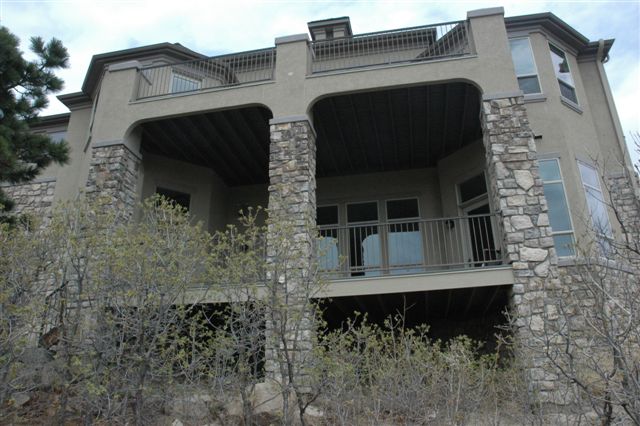
Multi-Story Deck on Hillside in Douglas County, Colorado

That is a question that we at Outdoor Lighting Perspectives (OLP) of Colorado are frequently asked this time of year as homeowners look forward to using and enjoying their outdoor spaces.

Our response is that it is never too late to add deck lighting. At a project that we completed this week, the homeowner wanted to have deck lighting installed in the back yard in addition to landscape and architectural lighting for the front yard.

The only existing lighting on the upper deck consisted of two unshielded line voltage carriage lights. When these lights were turned on, the glare ruined the entire ambience of the evening as well as the view of Castle Rock beyond. The homeowners requested the following:

  • They wanted three deck lights installed on each of the stucco columns on the upper deck.
  • They wanted to be able to control the deck lights manually via a switch inside the house – next to the door leading out to the upper deck.
  • They did not want to see any exposed wiring.
  • They wanted to have both automatic and manual control options for the landscape lighting in the front yard.

Our installation crew was able to open a small access hole at the bottom of the center column and at the top – and to successfully pull the low voltage wiring home run to the upper deck. From there, the connections to the other two deck lights could be made and wiring pulled to each of the deck light locations. In a few spots, the wiring was hidden at the base of the columns with moulding strips painted to match the stucco.

Deck Light Installed on Stucco Column

The final result looks like the lighting was installed at the same time as the deck – no visible wiring and no visible conduits. The deck lights were also painted to match the stucco after this photo was taken so that they would blend in to and become part of the column itself.


New Switch for Deck Lighting Is a Snap with LCA

Lastly, the manual control of the newly installed deck lights was easily accomplished through the use of OLP’s Lighting Control Automation™ (LCA). The low voltage transformer powering the deck lights was mounted under the lower deck – and on a different electrical circuit than the switches shown in the photo. The switch on the left side controls the carriage lights on the deck – and the switch on the right controls the lights in the dinette. The switch on the right side originally looked exactly the same as the one on the left.

In the photo, the switch on the right was replaced with one of our LCA intelligent switches (note the LED at top), and instead of a solid Decora switch plate – it is now split in half vertically. The left side now controls the dinette lights as before and the right side now controls the new deck lights. Through the use of LCA technology, the deck lighting switch sends a signal from this totally unrelated electrical circuit over to the circuit powering the transformer. It was as simple as that – no new extensive hard-wiring nor interior drywall/painting repairs were required to accomplish this.

 
So it’s never too late to add to add deck lighting to your outdoor spaces – and summer is right around the corner!
 

What Has Twice the Life and Half the Price of LEDs?

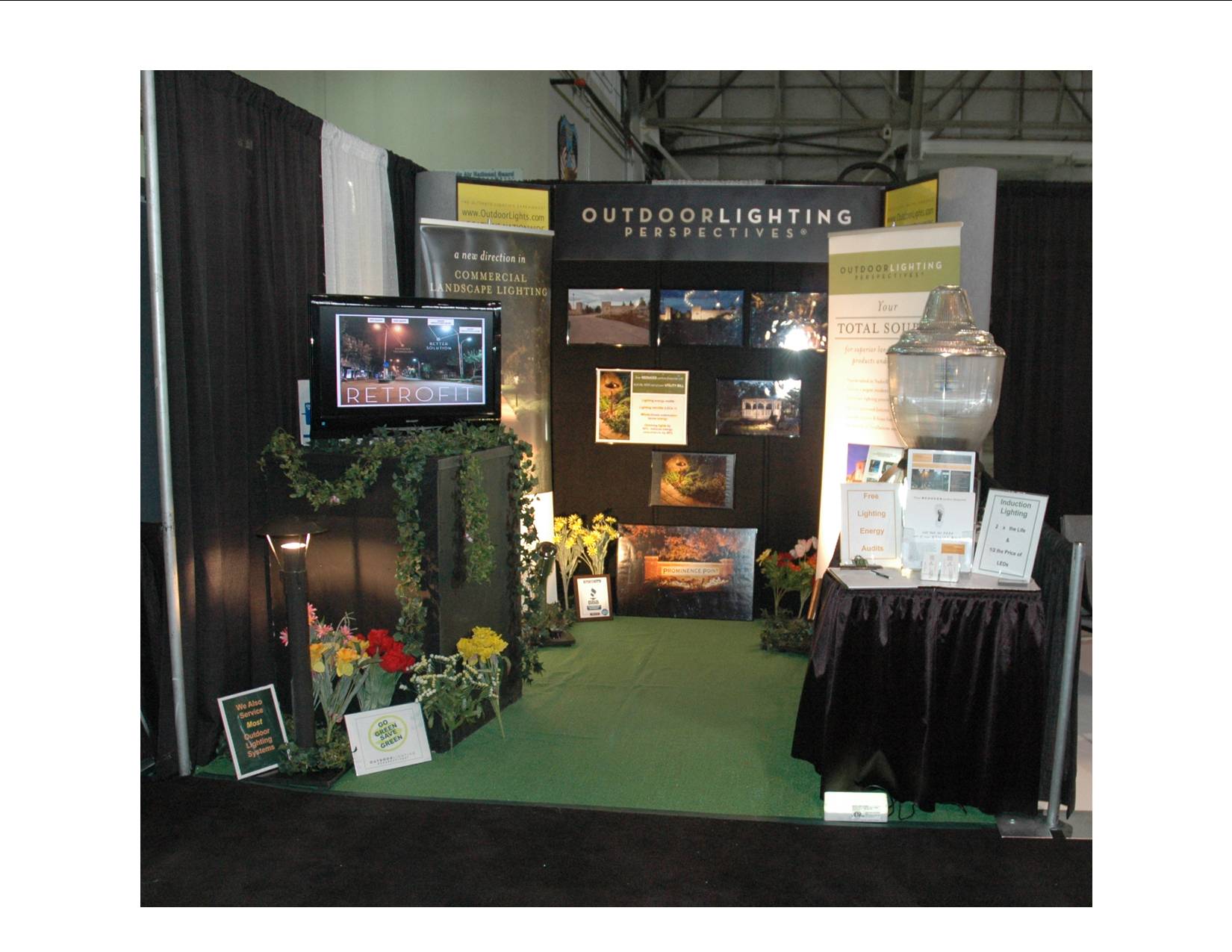
2011 CAI Colorado Trade Show

Outdoor Lighting Perspectives of Colorado launched its line of induction fluorescent lighting fixtures and retrofits last week at the CAI Colorado Trade Show. In case you were unable to attend the show, I have included photos and a video about our exhibit and the exciting energy saving possibilities with induction lighting.

OLP of Colorado Exhibit at CAI Trade Show

A few attendees to the show had previously heard about this new induction fluorescent technology. However, most of the attendees who stopped by our exhibit were amazed by the 100,000 life of these induction lamps.

Induction Fluorescent Lights

They were also pleasantly surprised to learn that currently induction lights have twice the life and half the price of LEDs. When fixtures are hard to reach easily (wall packs on the sides of condo buildings or street lights through a community), maintenance costs become problematic – and having a fixture with a 100,000-hour lamp life becomes very attractive. Our corporate commercial lighting website has been updated to include energy lighting audits and retrofits – Switch Your Lights – and locally we have been approved and listed in the ReDirect Guide for green and sustainable businesses and products.

For more information, please watch the following video from the show:
 

Come See Us at the CAI Spring Showcase & Trade Show

Come see us at the 2011 CAI Spring Showcase & Trade Show – Friday April 29th from 7 am to 4 pm (Booth # 104) at the Wings Over the Rockies Air & Space Museum – 7711 E. Academy Blvd. in Denver. The theme of this year’s event is Traveling Through Time with Your HOA.

Outdoor Lighting Perspectives (OLP) of Colorado will be exhibiting the latest in ceramic metal halide, LED, and induction fluorescent lamp/fixture technology for a wide range of typical HOA lighting applications including area lighting (street, park, walkway); signage/monument lighting; and stairwell/building lighting.

The new induction fluorescent technology offers increased performance life (up to 100,000 hours) with dramatically lower operational (up to 50-percent energy savings) and maintenance costs. Further, it offers a vast improvement over High-Intensity Discharge (HID) fixtures with respect to nighttime visibility and color rendering.

One of the new programs that OLP of Colorado is offering is a Free Energy Savings Assessment – so that HOA’s and building owners can assess retrofit and replacement payback periods for different lamp technologies. So if you are involved with a community or an HOA, please plan to stop by and see us.

Outdoor Lighting Perspectives Launches New Commercial Lighting Program

Induction Fluorescent Retrofits

Two weeks ago I had the privilege of attending a new and exciting commercial lighting training class at our company headquarters in Richmond, Virginia. The class focussed on new “green” lighting technologies (LED and induction fluorescent) for commercial applications such as area lighting (street, park, walkway, etc.), parking garage lighting, and wall and warehouse lighting. Almost all of these lighting applications can be found at apartment/townhome communities, business parks, parking garages, auto dealerships, warehouses, restaurants, etc.

Our company will be offering Free Energy Savings Assessments (Lighting Energy Audit/Payback Period) – and show how replacing outdated outdoor lamps (especially High-Intensity Discharge (HID) (high pressure sodium, metal halide) lamps) with our new LED and induction fluorescent retrofits can save a client up to 50% in their electrical bills.

Induction flourescent lighting has an extremely long performance life of up to 100,000 hours (over 22 years!) – that’s 5 to 8 times longer than the typical HID lamps. This technology offers a very high system efficiency with dramatically lower electrical bills and operational maintenance costs, and much better nighttime visibility. Additionally, federal government tax deductions provided through EPAct  (Energy Policy Act of 2005) for reducing building energy usage are in effect through the end of 2013 for interior applications such as parking garages, warehouses, and other commercial buildings. Additionally, many electric utilities such as XCEL Colorado  offer rebates for new green lighting installations or retrofits. OLP of Colorado will assist you in identifying all of the rebates, tax deductions and/or credits for which your particular project may be eligible.


Induction Fluorescent Lighting Compared to HPS

The photo above clearly demonstrates the excellent Color-Rendering Index for induction fluorescent lighting as well as its overall efficiency. Whether it’s for a completely new lighting installation or a retrofit opportunity, induction fluorescents are becoming more widely used. 

 
While LEDs are part of everyone’s current vocabulary, induction fluorescents are less well-known. However, that is about to quickly change because …
 
Induction Fluorescents     =     Twice the Life & Half the Price of LEDs!
 
You can learn more at SwitchYourLights.com.