Custom Low Voltage BBQ Light

Custom BBQ Light

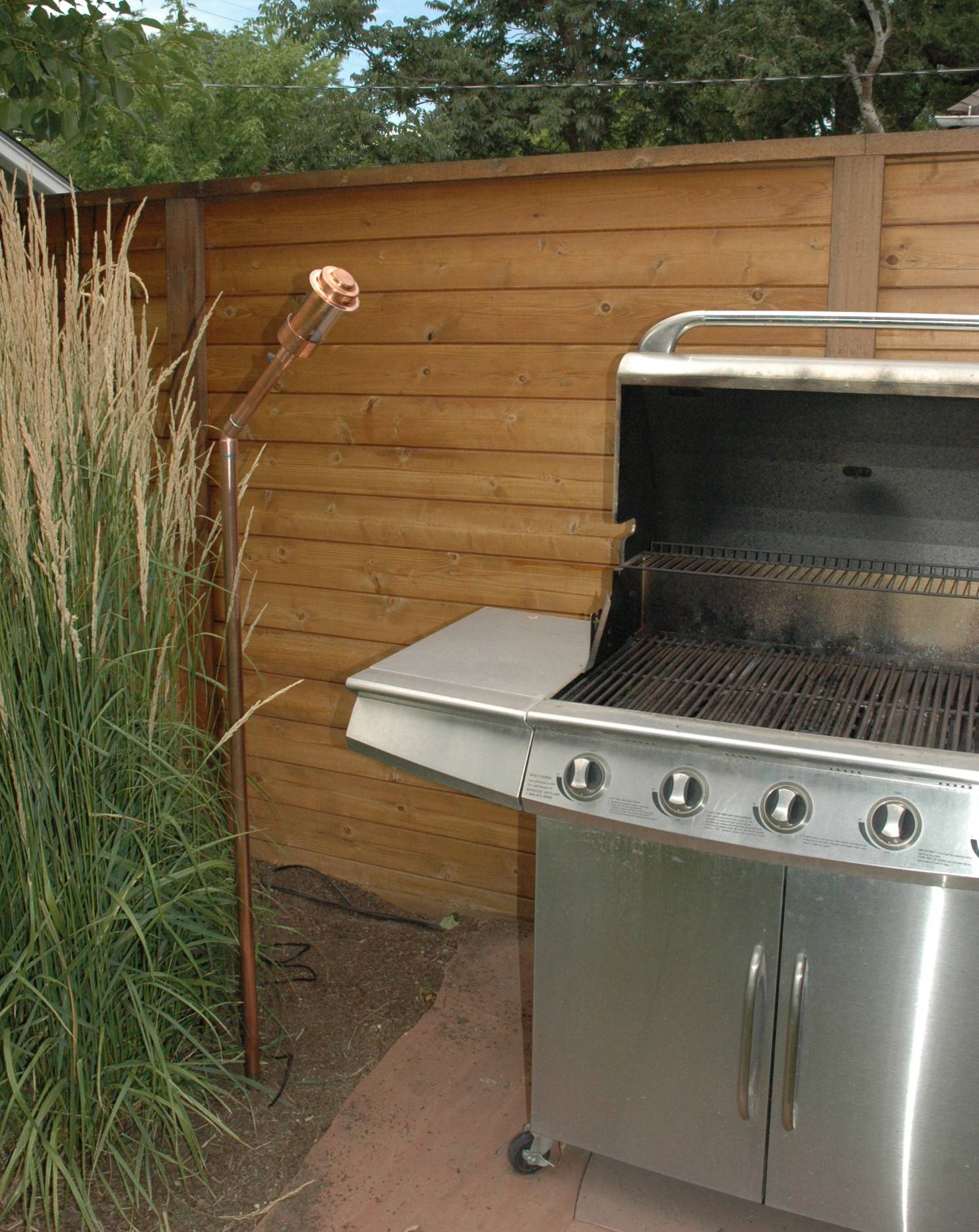
One of the advantages of being part of a large national/international lighting company is our ability to craft and install custom low voltage landscape/architectural lighting fixtures for our clients when the need arises. Last week we did a project for a customer who asked during the installation if there was a way to illuminate his barbecue grill. The customer wanted the ability to turn the BBQ light on and off separately from the rest of the landscape lighting system. The other requirement was that the customer did not want the lighting fixture attached in any way to the fence.

Our factory manufactures the copper BBQ lighting fixture assemblies with the black rubber all-weather switch and bulb socket assemblies. Our crew modified the assembly by installing a slightly larger copper flood head and mounting it at a 45-degree angle. By using an additional length of copper as well as one of our company’s heavy-duty underground PVC anchoring stakes, we were able to install the entire assembly behind some ornamental grasses.

The copper once it develops a patina will blend in nicely with the surrounding vegetation and fencing. The design and installation of this BBQ lighting fixture pretty much summarizes the goal of Outdoor Lighting Perspectives – and that is to emphasize the overall lighting effect with functional, unobtrusive, and durable lighting fixtures.

Custom Lighting Fixture Next to BBQ

Important Questions to Ask Before Hiring a Landscape Lighting Contractor

As with any home improvement project, homeowners need to peform their due diligence on prospective contractors (including landscape lighting) before any project is begun. Many homeowners ask why they should work with us and our response is typically “maybe you shouldn’t.” That response can be a bit disconcerting to most homeowners but almost immediately they understand the point we’re trying to make. And that point is that until you ask the right questions and receive the answers you’re comfortable with and do the background checks on a particular company or companies, you really should not be proceeding with any project until that due diligence is completed.

The following are some questions we’ve been asked over the years – and others that homeowners should be including as well:

BUSINESS LICENSING/REGISTRATION/INSURANCE?  Is the business registered and in good standing with the Colorado Secretary of State’s office? Does the company have the appropriate state and municipal operational and tax licensing? Does the company carry the appropriate property and liability insurance?

BBB RATING?  Is the company listed as an Accredited Business by the Better Business Bureau and what is its rating? For example, Outdoor Lighting Perspectives of Colorado is listed as an Accredited Business by the Denver-Boulder Better Business Bureau and currently holds an A+ rating.

HOW MUCH LIGHTING EXPERIENCE DOES THE COMPANY HAVE?  Outdoor Lighting Perspectives (OLP) of Colorado has been operating since 1999 – and our national company has been operating throughout the country since the late 1980s and early 1990s. Lighting is the only thing we do day in and day out – so we have to be really focussed and good at what we do. As part of a large national/international company with over 60 offices, we receive frequent and on-going training with respect to the latest lighting products and technology, design and installation techniques, and customer service. Interestingly, about 85% of the lighting companies operating in the Denver-Boulder area in 2001 are no longer in business.

HOW MANY LIGHTING INSTALLATIONS HAVE YOU DONE? The old saying is that anyone can sell you lights, but not everyone can provide you with an effective and high quality lighting installation. The number of installations a company has done is directly related to their level of expertise and professionalism in being able to handle any type of project. OLP of Colorado has close to 1,500 installations under its belt – from the plains of Fort Morgan to a two-mile high mountain-top and all along the front range of Colorado. Companies who only do lighting as a sideline business typically never get close to us with the breadth and complexity of the jobs we tackle.

CAN THE COMPANY PROVIDE REFERENCES? Good and reputable companies should never be reluctant to provide reference sites to prospective clients. However, from a lighting design standpoint every homeowner has different tastes and even different budget ranges in mind. That’s one of the reasons that we provide the free evening lighting design demonstration so that every design is customized for each homeowner.

WILL THE COMPANY PROVIDE A PREVIEW? As a follow on to the previous topic, any good lighting contractor should be able to provide you with an evening design demonstration so that you can see what the system will look like prior to the installation.

WHAT WARRANTIES COME WITH THE SYSTEM? Obviously, warranties are only as good as the company that backs it up. We once had a prospect (now a customer) who had asked one of our competitors “whose lifetime?” when he spotted their “lifetime warranty” banner hanging somewhat precariously in their exhibit. As I mentioned above, most of the lighting companies in business locally in 2001 are no longer around.

ASK ABOUT THE COMPANY’S SERVICE/MAINTENANCE PLANS Do they provide service after the sale? More often then not a lot of homeowners find out too late that the company that installed their lights provide no help after the installation.

FIND OUT WHO DOES THE ACTUAL INSTALLATIONS Does the contractor have their own factory trained employees or do they pick up day-hires with limited on-site training? Do they provide workmans comp, etc. Do they only hire and employ workers who are in the U.S. legally.

WILL MY LANDSCAPING AND SPRINKLER SYSTEM BE DAMAGED? Reputable and experienced lighting contractors should leave your property as good or better than it looked before the lighting installation was started. One of the best compliments our crews receive at the end of the day from a homeowner is that it looks like they had a lot more work to do since they didn’t notice any disruption to the landscaping. And that’s the entire point – the homeowner should not see anything different about the landscaping except for the fixtures as well as the beautiful illumination in the evening.

All of our trenching is done by hand with thin slices in lawn areas. After the wire is buried, the sod folds back over and most homeowners cannot tell where the wiring had been run. With regard to sprinkler systems, occasionally one of our crews does cut a line but it is our responsibility to fix it. If the sprinkler system is more complex than what we’re experienced with, we can call in one of several irrigation companies to complete the repairs.

Of course there are many more questions that homeowners can and should ask with respect to contractors in general and lighting contractors in particular, but hopefully I’ve addressed the primary questions today in this short blog.
Force of Mother Nature and Outdoor Lighting

Back Yard Fire Caused by Overhead Power Line Being Snapped by Falling Tree

We design and install our landscape and architectural lighting systems to withstand almost everything mother nature can throw at them – from six foot deep snow drifts in the winter time, driving rain in the spring and summer time, and to salty environments in the coastal locations. But sometimes Mother Nature  lets you know that she’s really a force to be reckoned with.

On Monday of this week, the Denver metro area endured sustained winds of 45 mph with gusts to 70 mph- a few mph under hurricane force winds. I had been out in this wind with one of my crews and several times we almost got swept off our feet. Sure enough the phone rang several times the next day with calls from customers saying that some of their fixtures had been damaged by wind-blown debris.

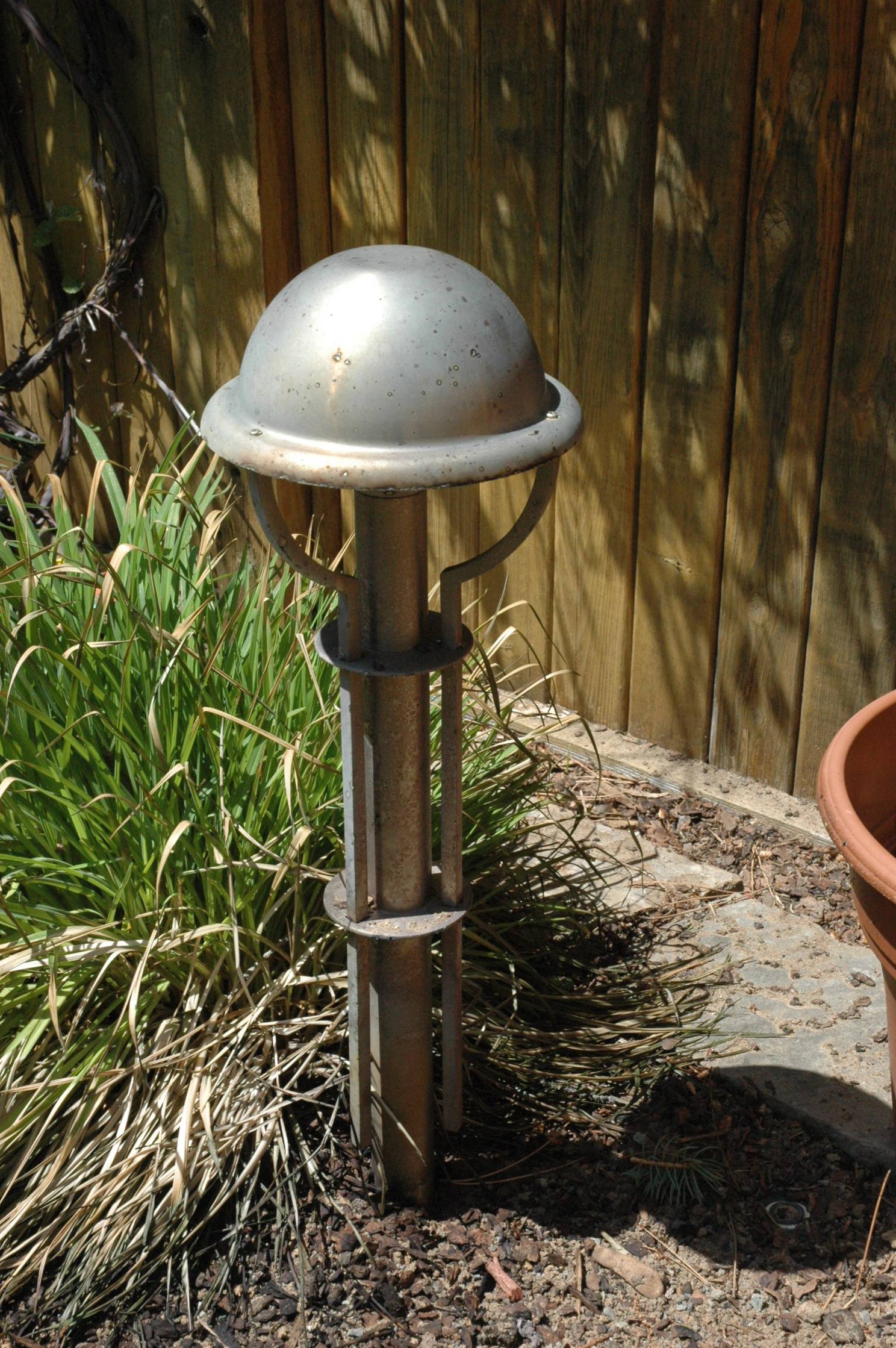
The most major damage, however, was reported by one of our customers in the Hilltop neighborhood. One of his neighbor’s trees was blown over by the wind and severed the overhead XCEL power line causing the 80-foot tree to instantly become a fireball. One of the Kichler modernistic brushed nickel path lights can be seen in the photo below after the fire.

Thankfully, neither the homeowner’s family nor any of his neighbors were injured by the falling tree that was on fire or by the high voltage line that had just been severed. In fact, if you ever see a cut loose overhead wire on the ground or dangling from the air – NEVER, EVER approach it. Call 911 immediately so that the utilties can be called to cut the power as soon as possible. It may literally mean the difference between life and death to another unsuspecting passerby.

The other thing that happened was that the high voltage overhead power line sent a surge through the low voltage lighting system that in turn blew out the low voltage transformer and the GFI wall outlet. The good news is that our stainless steel transformers are designed and manufactured to code to be able to contain a catastrophic event such as this one. And the GFI outlet tripped and then failed preventing the outside surge from entering the rest of the house’s wiring system.

We just started our 12th year of installing lighting systems in Colorado, and this is the first time that we ever had an overhead line voltage power line get severed and then cause all of this other damage. After checking with our factory in Nashville, the folks there who have been doing this for over 20 years have never experienced a scenario such as this one. They have experienced damage to lighting systems due to lightning strikes but not from overhead power lines being severed.

Our Nashville office is currently dealing with the aftermath of the major flooding with respect to the repair and re-installation of entire lighting systems. And of course our New Orleans office is still dealing with the devastating effects from Hurricane Katrina. All we can do is to make our lighting systems as foolproof and as safe as possible, but sometimes Mother Nature reminds us who is really the boss.

What Does it Cost to Operate a Landscape Lighting System?

Over the years a lot of homeowners have asked us how much their monthly electricity bill would increase after their landscape lighting system was installed. The short answer and the good news is not very much!

Most recently some townhome owners in Denver needed to share a low voltage quartz halogen landscape lighting system to illuminate their front entrances. The as-built configuration of the townhomes dictated that only one of the townhomes would have the low voltage transformer installed – and subsequently would have to provide all of the power for the entire lighting system. The respective homeowners agreed to split the annual electricity bill/usage for the system and asked me to compute how much that would be.

For this system, there were a total of two uplights (well lights at 35W each) and four path lights for the walkways (at 20W each) – for a total energy usage of 150W. For safety and security, the homeowners wanted the lights to be on from dusk to dawn throughout the year.

By accessing the U.S. Naval Observatory website and doing some computations, I was able to determine that there are a total of 4,306.29 hours of darkness for the entire year in Denver, Colorado. By multiplying 150W times 4,306.29 hours you get 645,943.5 watt-hours or 645.9 kWH. The average cost per kilowatt-hour in Denver is projected to be 11.3 cents through the year. By multiplying $.113/kW-H times 645.9kWH, you end up with a total operating cost of $72.99 per year, or $6.08 per month or $.20 per night. Most police departments will tell you that this is a small price to pay to enhance your home’s safety and security every night of the year.

Ken-Caryl House Lighting

The house on the left (also using a low voltage quartz halogen lighting system) has a total of 8 uplights (35W each) and 3 path lights (20W) each – for a total of 340W. Dusk to dawn operation costs $165.44 per year or $13.78 per month or $.45 per night.

If this same low voltage quartz halogen system is replaced by a low voltage LED lighting system in the future, the total power requirement would only be 80.7W and would result in annual energy costs of $39.26 per year or $3.27 per month or $.11 per night – a 76-percent energy savings over the quartz halogen system.

So in other words LEDs are the future but even with a low voltage quartz halogen lighting system, you’re still saving money with operating your outdoor lighting in comparison to line voltage lighting.

Flying High with CAI – Spring Showcase and Trade Show

Outdoor Lighting Perspectives (OLP) of Colorado will be exhibiting at the Rocky Mountain Chapter of the Community Associations Institute Spring Showcase and Trade Show with this year’s theme FLYING HIGH WITH CAI. Being billed as the biggest trade show in the chapter’s history, the event will take place on May 5 from 7:00 am to 6:00 pm at the Wings Over the Rockies Air and Space Museum located at 7711 East Academy Boulevard in Denver.

OLP of Colorado will be showcasing the latest energy efficient lighting products for illuminating community entrances, parks, clubhouses and common areas. LED, ceramic metal halide, and quartz halogen fixtures will be on display, and multimedia photos will show what actual installations look like after dark.

The event provides an opportunity for hundreds of community/HOA managers, property managers, and contractors to interact and attend the trade show and educational sessions.

Between the hours of 4:00 pm and 6:00 pm, friends, family and business associates of OLP of Colorado are welcome to come visit us (Booth #74) and stroll throughout the air and space museum to view the historical aircraft and aerospace exhibits. As a former aerospace engineer, I know I can’t wait!

We look forward to seeing you there!

Celebrate Earth Day Today!

Celebrate the 40th Anniversary of Earth Day today – April 22, 2010. I’m actually old enough to remember the first Earth Day when I was a sophomore at Penn State. Earth Day has certainly come a long way since then. Fortunately more and more people worldwide are beginning to live their lives and run their businesses as though Earth Day were every day of the year!

At Outdoor Lighting Perspectives (OLP) of Colorado, we certainly emphasize the use of energy efficient lighting products such as low voltage quartz halogen, low voltage LED, line voltage Ceramic Metal Halide, line voltage induction fluorescent, and Lighting Control Automation™ for our residential and/or commercial customers. For interior lighting, Compact Fluorescents (CFLs) and LEDs are helping to greatly reduce homeowners’ energy usage as well.

Sometimes, even the little things add up. In OLP’s business operations we recycle copper wiring and the copper cores of low voltage transformers, stainless steel transformers, office papercardboard, and aluminum cans. For service calls and installations, we route and schedule our crews/vans to minimize travel time and mileage.  To improve fuel economy, we off-load unnecessary inventory/tools and ladders on roof racks before heading off to that day’s job tickets.

To take part in Earth Day festivities being held this week in Colorado, please take a look and participate in the events shown below:

EARTH DAY 40TH ANNIVERSARY NREL Visitors Center, Golden; April 19 – 23; free events during the week; www.nrel.gov

EARTH DAY ON EAST MOUNTAIN – 240 – 262 E. Mountain Avenue, Old Town Fort Collins; April 22. Block Party – celebrate Earth Day with live music/food, demos and presentations about growth and sustainability. www.facebook.com/home.php?#!/event.php?eid=105316966166440&ref=ts

DENVER BOTANIC GARDENS – 1007 York St., Denver; April 22; FREE DAY for Colorado residents; www.botanicgardens.org

EARTH DAY AT RED ROCKS – Saturday, April 24; Red Rocks Amphitheater; Morrison. Eco-friendly events – musical performance by Aspen Meadow, wolves from W.O.L.F. Sanctuary, clean up event at the park and environmental displays. www.windstarcoloradoconnection.org

PIKES PEAK EARTH DAY – Saturday April 24; Cornerstone Arts Center – Colorado College, Colorado Springs. Theme – 40 Years of Earth Day – ReVision, RePurpose, ReNew. www.Pikespeakearthday.org

EARTH FEST 2010 – Sunday, April 25; downtown Boulder – Central Park, Bandshell and Farmers Market. Eco activities/events – renewable energy demos, 5th Annual Dirt Day Advanced Challenge/EXPO, live music and organice food. www.earthfestboulder.net

So whether you celebrate at one of these events or by doing something for Mother Earth at home, have a good time and remember that Earth Day should be every day of the year!

Sleeves Make Landscape Lighting a Lot Easier

Examples of 1.5-, 2.0-, 4-inch diameter sleeves

Many homeowners this time of year are contemplating or even starting home improvement and landscaping projects, including new walkways, patios or driveways. With any type of hardscaping project, please make sure that sleeves are installed beneath any new concrete or brick pavers so that irrigation pipes/control wiring, lighting wiring, and speaker/sound system wiring can be installed at any time after the new hardscaping surfaces have been completed. Above you can see examples of the typical sleeve diameters used for most residential installations.

So what are sleeves exactly? They are heavy-duty polyvinyl chloride (PVC) conduits through which sprinkler irrigation and other wiring can be easily run whenever that phase of the project is ready to begin. Typically, hardscaping contractors will indicate the positioning of the sleeve(s) by a “vee”-shaped notch in the edge of a sidewalk or driveway for example. This saves a lot of work searching for sleeves as well as a lot of unnecessary disruption to the surrounding landscaping.

Since sleeves are relatively inexpensive compared to the increased time and labor cost of boring under a wide driveway, for example, my recommendation is to always install more sleeves than you think you’ll ever need. The other rule of thumb is not to use the same sleeve for both electrical wiring and irrigation pipes, for obvious reasons.

In fact today our crew was doing a lighting installation at a community entrance where the sleeve under the street has become a major headache. The original landscaper installed only one 4-inch diameter sleeve under the street – and then proceeded to run both the 2.5-inch irrigation pipe and all of the irrigation control wires through that same sleeve. Of course, the water and the electrical wiring should have been in separate sleeves. If that had been the case, our low voltage wiring could have easily been pulled through the wiring sleeve. As it is now, we’ll have to investigate other options including directional boring at $18 to $20/foot.

Community developers should also plan on providing line voltage power either behind entrance monuments or nearby to facilitate the installation of irrigation controllers, outdoor landscape lighting systems, and holiday lighting.

So the next time you’re planning an outdoor project, please do not forget the sleeves!

Outdoor Lighting Systems Do Require Maintenance

Yes, outdoor landscape lighting systems do require maintenance to keep them operating at peak performance. Most of our Outdoor Lighting Perspectives’ customers avail themselves of our Annual Maintenance Plans (AMP) so that the lighting system and the lighting effect look as good as the day the system was first installed.

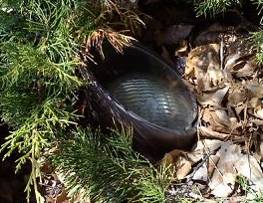
Well Light Requiring Cleaning/Vegetation Pruning

In Colorado, houses and landscaping get dirty through the winter months – and at the left is a photo of a well light prior to the AMP work being done. The lens cover is dirty and needs to be cleaned, the fallen leaves need to be removed, and the juniper needs to be pruned so that it does not block the light meant for the crabapple tree. Interestingly, last week we had a rain shower in Denver that left a deposit of reddish-tan dust on cars, house windows and landscaping – and the weatherman told us that evening that the dust had been carried all of the way from Mongolia!

Running an outdoor lighting system with dirty lens covers or lumen-depreciated bulbs is a total waste of energy. Imagine having to drive your car during all of the winter months without ever cleaning your headlights.

Quartz halogen bulbs lose roughly a third to a half of their lumen intensity on an annual basis. That’s why when the AMP is performed, all of the bulbs are replaced with new ones so that the lighting output and effect will be the same as when the system was brand new.

During the freeze-thaw cycles in Colorado and in communities with lots of active wildlife, it’s not uncommon for fixtures to become crooked or knocked out of place. Animals sometimes have a knack for pulling up wiring which also needs to be re-buried during the annual maintenance service.

Wiring That Needs to Be Buried

Wiring connections also need to be rechecked for tightness, especially in the transformer bays where internal temperatures can reach as high as 135-degrees Fahrenheit.

All landscaping has a way of maturing and spreading so that a well light that was properly located five years ago to light up a spruce tree, has now been swallowed by that same tree if proper maintenance has not been performed over the years. That’s one of the advantages of a low voltage system to be able to relocate the lighting fixtures as the landscaping matures.

Control systems for outdoor lighting systems should also be checked during this annual service visit. Even though low voltage lighting systems are very energy efficient, it does not make sense to be running the landscape lights an extra two or more hours a day during daylight hours if the system has not be set properly. That’s why we only use the Lighting Control Automation™ system for residential systems. There’s no mechanical timer to get out of synch because of a power outage or a photocell on a transformer that gets blocked by a roof overhang or tree that causes the system to turn on when it’s really not dark.

So either hire a professional or get out there and do the maintenance work yourself on your lighting system. Either way this annual maintenance will keep your lighting system at its optimum level for years to come.

Celebrate Earth Hour Today!

Tonight from 8:30 pm to 9:30 pm in each local time zone around the world, supporters of the World Wildlife Federation’s annual EARTH HOUR campaign will turn off their lights to take a stand against global climate change. While the energy savings for this one-hour effort may be minimal, more important will be the global show of support by making a visual statement for the sustainability movement.

Started in Australia in 2007, EARTH HOUR’S support has grown worldwide and some of the most famous buildings will go dark for one hour during their local 8:30 to 9:30 pm time period including Toronto’s CN Tower, San Francisco’s Golden Gate Bridge, Rome’s Colisseum, and Paris’ Eiffel Tower.

In Colorado, both the Governor’s Mansion and the State Capitol building will go dark for one hour. Governor Bill Ritter said that Colorado has become a great example of how a state can implement aggressive energy reduction goals while growing a New Energy Economy. I am proud that Colorado can be a part of this worldwide effort to bring attention to the dire consequences of global climate change.

Please join Outdoor Lighting Perspectives of Colorado in supporting this worldwide effort. We of course are trying to do our part by reducing the energy/carbon footprints of both our residential and commercial lighting installations. By introducing and installing energy efficient LED lighting systems for residential applications as well as Lighting Control Automation™ we are greatly reducing our customer’s usage of electricity. On the commercial side, we are installing energy efficient Ceramic Metal Halide fixtures.

LED Fixtures Do Melt Snow!

Close Up of LED Fixture at Diamond Ridge Installation

About a month ago there was a story reported around the country that many northern cities had been experiencing problems with their new LED traffic lights. Apparently in some of these cities, the LED traffic lights would not generate enough heat in order to melt the accumulating build up of snow and ice during the winter months. It was also reported in the local news that fortunately this has not been a problem in the Denver metro area with all of the hours of sunshine we typically receive.

Before we actually began using LED fixtures for architectural and landscape lighting, we also wondered how well our new and innovative fixtures would melt the snow. As you can see in the above photo, they do quite well – thank you.

The actual reason that these fixtures melt the snow is inherent in their initial design as well as manufacturing. The main factor that limits the life of the LEDs/electronics is the heat build up inside the fixture. Our manufacturer has placed the LED driver in the mounting stake for the fixture – not inside the fixture itself as have most manufacturers.

In addition, any remaining heat generated by the LED bulb itself is dissipated by means of cooling fins as shown in the Computer-Aided Engineering (CAE) thermal model below that was used to design a deck light. As a forner aerospace engineer, my expertise had been in thermal and fluid flow modeling for jet engines, rockets, spacecraft, and solar energy projects – so I tip my hat to the innovative engineers at our manufacturing company!

CAE Thermal Design Model for LED Deck Light

The fixtures are machined out of solid brass (aluminum is also an option) to provide the thermal heat exchange capabilities. Not only are the fins an engineering design feature, they add to the aesthetic appearance of the fixtures as well. By pulling the heat away from the LED bulb itself, the fins and fixture reach an outside surface temperature of 96-degrees F – enough to melt snow.

The design and testing of these fixtures have been on-going during the last seven years. Brass fixtures have a lifetime warranty, and the LEDs and electronics have had a five year warranty. However, we have heard that this warranty may be getting a lot better in the near future – so stay tuned!