Come See Us at the CAI Spring Showcase & Trade Show

Come see us at the 2011 CAI Spring Showcase & Trade Show – Friday April 29th from 7 am to 4 pm (Booth # 104) at the Wings Over the Rockies Air & Space Museum – 7711 E. Academy Blvd. in Denver. The theme of this year’s event is Traveling Through Time with Your HOA.

Outdoor Lighting Perspectives (OLP) of Colorado will be exhibiting the latest in ceramic metal halide, LED, and induction fluorescent lamp/fixture technology for a wide range of typical HOA lighting applications including area lighting (street, park, walkway); signage/monument lighting; and stairwell/building lighting.

The new induction fluorescent technology offers increased performance life (up to 100,000 hours) with dramatically lower operational (up to 50-percent energy savings) and maintenance costs. Further, it offers a vast improvement over High-Intensity Discharge (HID) fixtures with respect to nighttime visibility and color rendering.

One of the new programs that OLP of Colorado is offering is a Free Energy Savings Assessment – so that HOA’s and building owners can assess retrofit and replacement payback periods for different lamp technologies. So if you are involved with a community or an HOA, please plan to stop by and see us.

Outdoor Lighting Perspectives Launches New Commercial Lighting Program

Induction Fluorescent Retrofits

Two weeks ago I had the privilege of attending a new and exciting commercial lighting training class at our company headquarters in Richmond, Virginia. The class focussed on new “green” lighting technologies (LED and induction fluorescent) for commercial applications such as area lighting (street, park, walkway, etc.), parking garage lighting, and wall and warehouse lighting. Almost all of these lighting applications can be found at apartment/townhome communities, business parks, parking garages, auto dealerships, warehouses, restaurants, etc.

Our company will be offering Free Energy Savings Assessments (Lighting Energy Audit/Payback Period) – and show how replacing outdated outdoor lamps (especially High-Intensity Discharge (HID) (high pressure sodium, metal halide) lamps) with our new LED and induction fluorescent retrofits can save a client up to 50% in their electrical bills.

Induction flourescent lighting has an extremely long performance life of up to 100,000 hours (over 22 years!) – that’s 5 to 8 times longer than the typical HID lamps. This technology offers a very high system efficiency with dramatically lower electrical bills and operational maintenance costs, and much better nighttime visibility. Additionally, federal government tax deductions provided through EPAct  (Energy Policy Act of 2005) for reducing building energy usage are in effect through the end of 2013 for interior applications such as parking garages, warehouses, and other commercial buildings. Additionally, many electric utilities such as XCEL Colorado  offer rebates for new green lighting installations or retrofits. OLP of Colorado will assist you in identifying all of the rebates, tax deductions and/or credits for which your particular project may be eligible.


Induction Fluorescent Lighting Compared to HPS

The photo above clearly demonstrates the excellent Color-Rendering Index for induction fluorescent lighting as well as its overall efficiency. Whether it’s for a completely new lighting installation or a retrofit opportunity, induction fluorescents are becoming more widely used. 

 
While LEDs are part of everyone’s current vocabulary, induction fluorescents are less well-known. However, that is about to quickly change because …
 
Induction Fluorescents     =     Twice the Life & Half the Price of LEDs!
 
You can learn more at SwitchYourLights.com.


Celebrate Earth Day Tomorrow – and Every Day!

Earth Day 2011Celebrate the 41st anniversary of Earth Day tomorrow – April 22. Because Earth Day this year falls on a holiday weekend, some communities have decided to celebrate it on previous weekends or schedule events throughout the months of April and May. Most communities are holding recycling events or environmental clean up events to prevent hazardous materials and valuable reusable materials from unnecesarily taking up valuable space in our landfills.

Last week I attended a training class (more later) at our company headquarters in Richmond, Virginia. While there we learned how we can help reduce energy usage for commercial lighting (parking garages, parking lots, building lighting) by 50 percent with new technology. Homeowners are doing their part by replacing inefficient incandescent bulbs with energy-saving LEDs and compact fluorescent (CFL bulbs).

Here are some of the Earth Day events along the Colorado front range.

Denver Earth Day Eventwww.denvergov.org/EarthDay; Friday April 22; 10 am – 2 pm; Greek Theater at Civic Center Park

Colorado Springs Earth Day – Free Rides – Friday April 22. Free rides on Mountain Metro, FrontRange Express; and Ute Pass Express.

Earth Day Fort Collinswww.sustainablelivingassociation.org/earth-day-2011 ; Civic Center Park; Saturday April 23, 11 am – 5 pm.

Don’t scrap your old outdoor lighting fixtures for LED. Call us for a retrofit.

A lot of people stopped by our booth at the Colorado Garden & Home show asking if we can retrofit existing outdoor lighting fixtures with LED bulbs. The good news is – yes we can! The great news is the energy savings can be up to 90%. For example, standard path lights use a 20 watt quartz halogen bulb. We can replace that with 2 watt LED bi-pin bulb with energy savings of 90%. Watch this video to learn more.

Not All “Green” Bulbs Are Dimmable

This past week we had a customer call to say that he had a problem with his control system. Apparently he has replaced his soffit light bulbs at his front entrance several times during the past month, and the bulbs keep burning out within a few days. His soffit lights are controlled by one of our automated LCA switches, and they turn on every evening at sunset at a power setting of 65-percent.

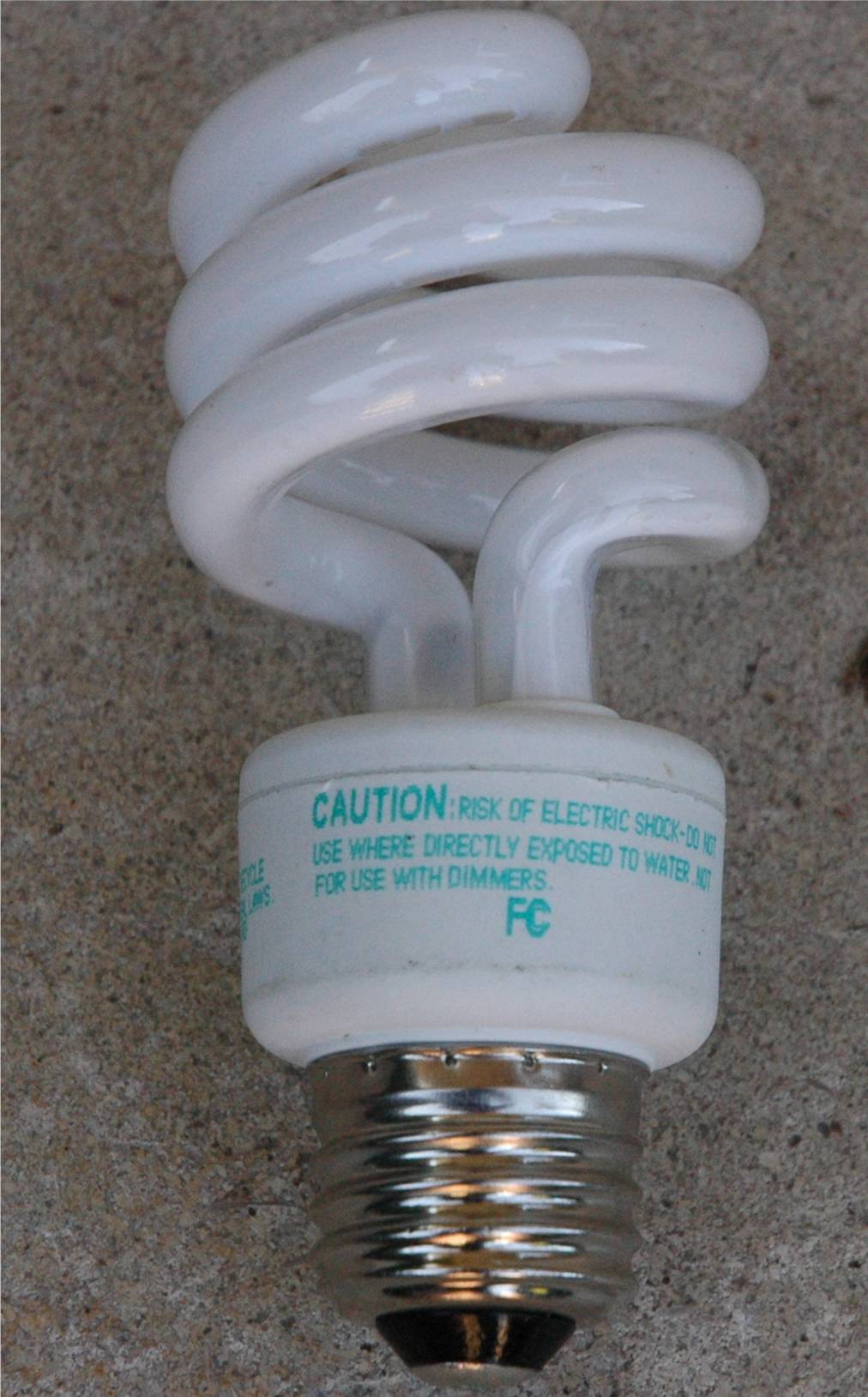
I had suspected that the customer had been using non-dimmable bulbs, and upon meeting up with our crew and removing the bulbs – our suspicions were confirmed. The bulb shown above is a standardly-used compact fluorescent (CFL) bulb (and available at all of the box stores), but clearly marked at its base are the words – … not for use with dimmers.
Before arriving at the site, I had purchased two replacement dimmable R30 flood bulbs that are dimmable – see photo below.
This 65-watt equivalent bulb uses only 15W of electricity, and when dimmed to the 65-percent power level it will be using less than 10W of power.
Ordinary incandescent bulbs are to be phased out in the U.S. by 2014 by an energy conservation act passed by Congress in 2007. In fact, the last GE factory making ordinary incandescent bulbs in the U.S. (Winchester, VA) closed last month.
As the incandescent bulbs continue to be phased out over the next several years, CFL’s will temporarily become their leading replacement, followed by halogen bulbs and finally LEDs. As everyone knows, LED’s are our long-term lighting future and that technology continues to become more efficient and less expensive as time goes on.
So in the short term, you’re doing a great thing by ridding your house and business of incandescent bulbs. Just remember though that you need to use dimmable CFL and LED bulbs in any circuit controlled by a dimmer.

Flying High with CAI – Spring Showcase and Trade Show

Outdoor Lighting Perspectives (OLP) of Colorado will be exhibiting at the Rocky Mountain Chapter of the Community Associations Institute Spring Showcase and Trade Show with this year’s theme FLYING HIGH WITH CAI. Being billed as the biggest trade show in the chapter’s history, the event will take place on May 5 from 7:00 am to 6:00 pm at the Wings Over the Rockies Air and Space Museum located at 7711 East Academy Boulevard in Denver.

OLP of Colorado will be showcasing the latest energy efficient lighting products for illuminating community entrances, parks, clubhouses and common areas. LED, ceramic metal halide, and quartz halogen fixtures will be on display, and multimedia photos will show what actual installations look like after dark.

The event provides an opportunity for hundreds of community/HOA managers, property managers, and contractors to interact and attend the trade show and educational sessions.

Between the hours of 4:00 pm and 6:00 pm, friends, family and business associates of OLP of Colorado are welcome to come visit us (Booth #74) and stroll throughout the air and space museum to view the historical aircraft and aerospace exhibits. As a former aerospace engineer, I know I can’t wait!

We look forward to seeing you there!

Celebrate Earth Day Today!

Celebrate the 40th Anniversary of Earth Day today – April 22, 2010. I’m actually old enough to remember the first Earth Day when I was a sophomore at Penn State. Earth Day has certainly come a long way since then. Fortunately more and more people worldwide are beginning to live their lives and run their businesses as though Earth Day were every day of the year!

At Outdoor Lighting Perspectives (OLP) of Colorado, we certainly emphasize the use of energy efficient lighting products such as low voltage quartz halogen, low voltage LED, line voltage Ceramic Metal Halide, line voltage induction fluorescent, and Lighting Control Automation™ for our residential and/or commercial customers. For interior lighting, Compact Fluorescents (CFLs) and LEDs are helping to greatly reduce homeowners’ energy usage as well.

Sometimes, even the little things add up. In OLP’s business operations we recycle copper wiring and the copper cores of low voltage transformers, stainless steel transformers, office papercardboard, and aluminum cans. For service calls and installations, we route and schedule our crews/vans to minimize travel time and mileage.  To improve fuel economy, we off-load unnecessary inventory/tools and ladders on roof racks before heading off to that day’s job tickets.

To take part in Earth Day festivities being held this week in Colorado, please take a look and participate in the events shown below:

EARTH DAY 40TH ANNIVERSARY NREL Visitors Center, Golden; April 19 – 23; free events during the week; www.nrel.gov

EARTH DAY ON EAST MOUNTAIN – 240 – 262 E. Mountain Avenue, Old Town Fort Collins; April 22. Block Party – celebrate Earth Day with live music/food, demos and presentations about growth and sustainability. www.facebook.com/home.php?#!/event.php?eid=105316966166440&ref=ts

DENVER BOTANIC GARDENS – 1007 York St., Denver; April 22; FREE DAY for Colorado residents; www.botanicgardens.org

EARTH DAY AT RED ROCKS – Saturday, April 24; Red Rocks Amphitheater; Morrison. Eco-friendly events – musical performance by Aspen Meadow, wolves from W.O.L.F. Sanctuary, clean up event at the park and environmental displays. www.windstarcoloradoconnection.org

PIKES PEAK EARTH DAY – Saturday April 24; Cornerstone Arts Center – Colorado College, Colorado Springs. Theme – 40 Years of Earth Day – ReVision, RePurpose, ReNew. www.Pikespeakearthday.org

EARTH FEST 2010 – Sunday, April 25; downtown Boulder – Central Park, Bandshell and Farmers Market. Eco activities/events – renewable energy demos, 5th Annual Dirt Day Advanced Challenge/EXPO, live music and organice food. www.earthfestboulder.net

So whether you celebrate at one of these events or by doing something for Mother Earth at home, have a good time and remember that Earth Day should be every day of the year!

Celebrate Earth Hour Today!

Tonight from 8:30 pm to 9:30 pm in each local time zone around the world, supporters of the World Wildlife Federation’s annual EARTH HOUR campaign will turn off their lights to take a stand against global climate change. While the energy savings for this one-hour effort may be minimal, more important will be the global show of support by making a visual statement for the sustainability movement.

Started in Australia in 2007, EARTH HOUR’S support has grown worldwide and some of the most famous buildings will go dark for one hour during their local 8:30 to 9:30 pm time period including Toronto’s CN Tower, San Francisco’s Golden Gate Bridge, Rome’s Colisseum, and Paris’ Eiffel Tower.

In Colorado, both the Governor’s Mansion and the State Capitol building will go dark for one hour. Governor Bill Ritter said that Colorado has become a great example of how a state can implement aggressive energy reduction goals while growing a New Energy Economy. I am proud that Colorado can be a part of this worldwide effort to bring attention to the dire consequences of global climate change.

Please join Outdoor Lighting Perspectives of Colorado in supporting this worldwide effort. We of course are trying to do our part by reducing the energy/carbon footprints of both our residential and commercial lighting installations. By introducing and installing energy efficient LED lighting systems for residential applications as well as Lighting Control Automation™ we are greatly reducing our customer’s usage of electricity. On the commercial side, we are installing energy efficient Ceramic Metal Halide fixtures.

LED Fixtures Do Melt Snow!

Close Up of LED Fixture at Diamond Ridge Installation

About a month ago there was a story reported around the country that many northern cities had been experiencing problems with their new LED traffic lights. Apparently in some of these cities, the LED traffic lights would not generate enough heat in order to melt the accumulating build up of snow and ice during the winter months. It was also reported in the local news that fortunately this has not been a problem in the Denver metro area with all of the hours of sunshine we typically receive.

Before we actually began using LED fixtures for architectural and landscape lighting, we also wondered how well our new and innovative fixtures would melt the snow. As you can see in the above photo, they do quite well – thank you.

The actual reason that these fixtures melt the snow is inherent in their initial design as well as manufacturing. The main factor that limits the life of the LEDs/electronics is the heat build up inside the fixture. Our manufacturer has placed the LED driver in the mounting stake for the fixture – not inside the fixture itself as have most manufacturers.

In addition, any remaining heat generated by the LED bulb itself is dissipated by means of cooling fins as shown in the Computer-Aided Engineering (CAE) thermal model below that was used to design a deck light. As a forner aerospace engineer, my expertise had been in thermal and fluid flow modeling for jet engines, rockets, spacecraft, and solar energy projects – so I tip my hat to the innovative engineers at our manufacturing company!

CAE Thermal Design Model for LED Deck Light

The fixtures are machined out of solid brass (aluminum is also an option) to provide the thermal heat exchange capabilities. Not only are the fins an engineering design feature, they add to the aesthetic appearance of the fixtures as well. By pulling the heat away from the LED bulb itself, the fins and fixture reach an outside surface temperature of 96-degrees F – enough to melt snow.

The design and testing of these fixtures have been on-going during the last seven years. Brass fixtures have a lifetime warranty, and the LEDs and electronics have had a five year warranty. However, we have heard that this warranty may be getting a lot better in the near future – so stay tuned!

Mead’s Article – Outdoor Lighting Makes a Statement for a Community – Published

Hi – it’s Cathy here. I just wanted to let you know that Mead’s article – Outdoor Lighting Makes a Statement for a Community was published in the December 2009 issue of Common Interests – a publication by the Rocky Mountain Chapter of the Community Associations Institute. Mead’s article in its entirety follows.


Outdoor Lighting Makes a Statement for a Community

Mead L. Noss, P.E.

Owner, Outdoor Lighting Perspectives of Colorado


Communities take great pride in the aesthetics of their public spaces and landscaped areas during the daytime, and in the evening a community’s outdoor lighting should also set the appropriate tone. Does the community seem warm and inviting (safe and secure)? Or does the lighting detract from the overall experience of the neighborhood? Are the residents enjoying the public spaces after dark with well-illuminated path and bikeways?

More often than not, outdoor lighting in communities can be improved greatly with modern bulb technology, fixtures, and more effective lighting design. How many times have you driven by a community entrance with beautifully landscaped flower beds in the daytime only to be aghast at the same location in the evening as the once-beautiful landscaping is now bathed in the harsh yellow light from high-pressure sodium floods? In the current economic times with increasing energy costs and reduced operating budgets, communities now have the option of enhancing their outdoor lighting without sacrificing safety, security, aesthetics, usability, or energy efficiency.

Safety and Security

With any outdoor lighting system, safety and security are paramount. A good community lighting plan begins at all of the entrances to the community. You certainly want homeowners and their guests to find the community easily after dark but more importantly you want emergency fire, police and medical crews to find their way there even more quickly.

Well-placed and directed lighting will enhance the view of security cameras at an entrance gate or community center. Additionally, the security and accessibility of community mailboxes will be enhanced with overhead lighting.

Clubhouses, parks and other public areas must be properly illuminated to prevent falls and injuries after dark, as well as to deter vandalism and other crimes. Street lighting especially at intersections throughout the community enables motorists to find street signs after dark and to allow pedestrians to safely enjoy their evening walks.

The security of individual homeowners’ houses is also improved by architectural and landscape lighting that illuminates both the home and the perimeter of the property. Any police department in the state or country will tell you that burglars will almost always target the homes without lighting rather than taking risks with homes that are well-illuminated.

One of the myths about security and outdoor lighting is that if a little lighting is good, adding much more lighting is better – right? Well, that’s not actually the case. If the lighting fixtures produce lots of glare, adding additional fixtures of the same type or increasing the wattage of the bulbs will actually produce more glare thereby reducing visibility and security. A truism of good lighting design is that the quality of light is always better than the quantity of light.

Aesthetics and Usability

The aesthetics and usability of the overall lighting found in a community is of the utmost importance. The impression of the community after dark should be warm and inviting without harsh lights or glare. How often have you driven into a community only to be blinded by unshielded carriage lights at the entrance or by unshielded carriage lights along the street on driveway columns?

There are two types of glare – nuisance glare and disabling glare – and carriage lights along the street really do approach the level of disabling glare, especially for older drivers. As we age, our eyes become more susceptible to the effects of glare and it takes us longer to recover our full vision.  

Misdirected flood lights from one neighbor’s house into the adjacent neighbor’s yard (called light trespass) is unpleasant and can be categorized as nuisance glare – and it certainly affects the usability and enjoyment of the affected neighbor’s yard or his/her night’s sleep if the lighting is visible from their bedroom.

Any time that a bulb source is visible to anyone living in or driving through a community, it means that the lighting and resulting energy costs are wasted because the lighting is not directed to only where it’s needed.

Energy Efficiency and Cost

One of the first rules of lighting design is to not specify more light than you need; i.e., do not use line voltage metal halide lighting fixtures where low-voltage quartz halogen or LED (light-emitting diode) fixtures might do. It all depends on the ambient lighting conditions, what needs to be illuminated, and how the space is to be used in the evening. Evening lighting demonstrations with different lighting and cost options can provide communities with meaningful and visual comparisons from which to base their future capital improvement decisions.

Recent technology has improved to the extent that lighting designers and contractors can now provide energy efficient lighting that is effective from both a lumen output and Color Rendering Index (CRI) standpoint. What exactly is CRI? CRI is the comparison of how well a particular light source emits a color approximating a noon time sun (See the following table).

COLOR RENDERING INDEX TABLE

LIGHT SOURCE CRI
Noon Day Sun 100
Great Color (color matching above 97)   95+
Good Color   80 – 94
Poor Color (where colors do not show)   79
Fluorescent and Induction Fluorescent   50 – 98
LED   70 – 80 (getting better)
High Pressure Sodium   50
Quartz Halogen   80 – 92
Metal Halide   80+
Ceramic Metal Halide   90 – 96


Ceramic Metal Halide bulbs (39W or 70W) with a 15,000-hour life powered by low-voltage or line-voltage systems provide the true color (90-96 CRI) that is desired for lighting entrances, parks, and clubhouses in the evening.

Quality low-voltage LED (light emitting diode) fixtures with 50,000-hour rated life bulbs have recently become available and with an acceptable and improving CRI. The tradeoff investment-wise is a higher initial cost with lower residual operating costs.

When comparing bulb sources and efficiency, another helpful term is the lumen. A lumen is the measurement of reflectant light off of a surface. This is how all light sources are rated as you can see in the following table:

LUMEN COMPARISON BY LIGHT SOURCE

LIGHT SOURCE LUMENS/WATT
Incandescent   8
Quartz Halogen  15 – 19
Mercury  30 – 40
LED  30 – 80
Fluorescent  40 – 80
Metal Halide  80 – 110
Induction Fluorescent  80
Ceramic Metal Halide  80 – 110
High Pressure Sodium 120


As you can see from the table, incandescent bulbs are very inefficient and high pressure sodium bulbs are very efficient, as long as you like everything looking yellow in the evening. With respect to energy efficiency and light quality, line voltage or low voltage ceramic metal halide and low voltage quartz halogen lighting systems are the best solution, with low-voltage LED lighting systems becoming more and more acceptable for certain applications. In fact, LED lighting installations powered by off-the-grid solar photovoltaic systems are the optimum solution for community areas requiring lighting but having no readily available source of power.

Maintenance

Warranties and maintenance costs become very important over the long term with respect to lighting systems – and communities and their respective homeowners should try to obtain the best warranties available. In addition, the best maintenance for any lighting system is usually provided by the original company that installed it since they are most familiar with the product and installation. However, not all companies that install lighting systems also provide maintenance so that is an important consideration when evaluating a contractor.

As with any other asset in the community, lighting systems need to be maintained on a regular basis to provide optimum performance and to serve the needs of the community. In closing, the appearance of any outdoor lighting system (daytime or evening) really does set an appropriate tone for the community.

Sources:

  1. Go Green, Save Green presentation, Outdoor Lighting Perspectives Commercial Lighting Division, 2008.
  2. Illuminating Engineering Society