Our Annual Meeting

Last week Cathy and I had the privilege of attending Outdoor Lighting Perspectives’ (OLP) Annual Conference that was held at the beautiful Amelia Island Plantation located near Jacksonville, Florida. I was asked to speak about our involvement with the Community Association’s Institute as well as some of our more interesting lighting projects for various HOAs in Colorado.

One of the best benefits of being part of a large national/international franchise system is the opportunity to discuss best business practices with other local franchise owners. In addition, two of OLP’s manufacturers were there to introduce new products and other technological advances.

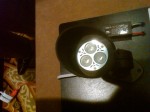
Shown at left is a new 6W LED replacement for a quartz halogen MR16 bulb-fixture. In addition to a complete new line of LED products, also unveiled was a line of commercial induction fluorescent fixtures, and an expansion of the ceramic metal halide commercial line.

It was a great break and it’s always fun to see the ocean – especially being from water-challenged Colorado. The important thing is that we learned a lot and are ready to move forward in 2010 to provide better service and products to our customers.

Another Reason to Use Lighting Control AutomationTM – Please Note the Intermatic Timer Recall

In a previous post, we highlighted state-of-the-art whole-house lighting control systems available today including the one we use, Lighting Control Automation™. We also mentioned some of the older technology still in use including the Intermatic electronic in-wall timer.

We just learned today that Intermatic has RECALLED 240,000 of their in-wall electronic timers because the product might pose a shock hazard to consumers trying to replace a battery. The model numbers include ST01, ST01C, ST01AC, ST01AC70, ST01C70, ST01CL, EI600C, EI600LAC, EI600LAC8, EI600WC and EI600WC8. These switches typically replaced an existing toggle or decora switch, and were sold at electrical supply houses and other retail outlets nationwide between March 2007 and June of this year.

If you have one of these switches, you can obtain details about this recall by calling 877-417-4316; online at Intermatic.com; or by accessing the website of the U.S. Consumer Product Safety Commission.

That is truly one of the great benefits of our Lighting Control Automation system, in that each intelligent switch does not need or even require a battery back up. Once the switch is programmed, the program is preserved forever and batteries are not required to back up the memory. In addition, there is no need to keep reprogramming the on and off times throughout the year since Lighting Control Automation does that for you automatically.

Lighting Controls Save Energy/Money and Enhance Security

For many years, lighting control was simply thought of as a manual switch that enabled a homeowner to turn on or off the front porch or carriage lights, or outside landscape lighting system. The problem with that control system is that someone would either forget to turn the lights on when it got dark or invariably forget to turn them off during the daytime. That inevitably wastes energy and money. Many homes today still have three or four sets of switches along the entire length of the house that someone has to manually control twice each day.

Photocells were sometimes added to control exterior line voltage lights as well as low voltage lighting systems over the years – and the lights run at full power from dusk to dawn or longer, depending on the location of the photocell. The other problem is that if you have several lighting zones, it is virtually impossible to synchronize the lights; i.e, some lights may be turning on or off as much as an hour earlier/later than other lights. Photocells work great for public or commercial properties where dusk to dawn lighting is deemed necessary for public safety/security. However, for most residential applications, a photocell is wasteful because the homeowner is paying for lighting all night long – even when they might only need it to say 11:00 PM.

Then someone got the bright idea of combining the photocell with a mechanical timer (on a low-voltage lighting transformer) or an electronic timer on a switch inside the house that controls carriage lights, for example. In the case of the low voltage lighting system, that works great until there’s a power outage and the timer no longer has the correct current time. And if you have multiple lighting zones, the lights are invariably coming on and going off at different times. The other disadvantage is that you also do not have the ability to manually turn the lights on and off from inside the house.

In the case of the electronic timer used in an in-wall switch (Intermatic is used a lot), it may work fine for one set of exterior lights but there is no way to synchronize all of the lighting circuits so that they operate at exactly the same time. Most of these Intermatic switches have been installed by do-it-yourself homeowners – and many times we’ve found that they’ve actually been unsafely overloaded.

More sophisticated whole-house automation systems have been in use in recent years including Lutron (hardwired and RadioRA), Control 4, X10 and others. The hardwired Lutron systems are typically used in large new homes over 10,000 square feet and we have many lighting systems that interface with this control system. We also have experience with Control 4 and Lutron’s RadioRA systems – both of which use wireless technology. Our experience is that the more control nodes that the homeowner adds throughout the house, the more robust and reliable the control system becomes. So if you need to send a signal over long distances and there are not many nodes in between, this wireless technology can be problematic.

We started off using the X10 control system ten years ago – but dropped it over three years ago because of unresolved technical issues. As it turns out, the X10 technology was not able to overcome the signal interference problems caused by the new electronic devices increasingly common in today’s home.

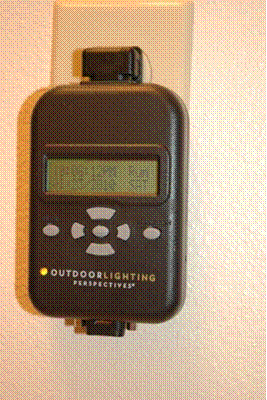
So what we’re now using for all of our residential installations is Lighting Control Automation™ (LCA) which is based on Universal Powerline Bus technology. We can control all of the low voltage lighting transformers and any or all of the interior/exterior line voltage lights from a single controller that is plugged into an interior outlet.

Once the controller has been programmed, you can plug it in and forget it. The device automatically adjusts on/off times according to the daily astronomical sunset/sunrise times for the home’s specific latitude/longitude, and it automatically adjusts for daylight savings/standard time and leap year as needed.

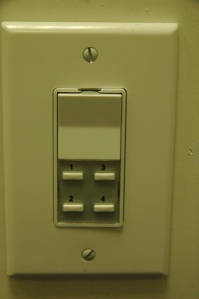
What once were standard “dumb” mechanical switches can be converted to Lighting Control Automation “intelligent” switches with a series of different faceplates  – that would enable you to be able to control from one to eight different other circuits throughout the house.

The beauty of the LCA system is that it can do roughly 85-percent of what a Lutron control system can do – at about one-third of the price. And the LCA system does not have to be hard-wired because it uses the existing house wiring and is an excellent choice for remodels as well as retrofits.

So what kind of applications can be handled by Lighting Control Automation? Almost anything and everything:

–  automate your front carriage lights to operate at 85-percent power to save energy and to turn off automatically; never waste power again because you forgot to turn the lights off before going to bed. This dimming level will also ensure that the carriage lights become integrated with the overall lighting effect, instead of otherwise ruining an effective design because they cause too much glare.

–  automate the lights in any room of your house and randomize the on/off times when you are away to give the house a lived-in look to deter vandalism.

–  automate a SECURE-ENTRY scenario whereby interior lights turn on when you turn into your driveway or use your garage door remote.

– automate your basement and rec-room lights so that they never get left on overnight again

–  provide a warning light to notify the homeowner that the garage door was left open before turning in for the night

–  in hot weather, automate a ceiling fan or automatically lower solar blinds to keep the house cool.

–  provide an ALL-LIGHTS ON scenario in case a noise is heard in the middle of the night.

–  if you have children who have difficulty waking during the dark mornings during the wintertime, LCA can mimic a sunrise by having a table lamp slowly get brighter over time.

The number of possible applications for Lighting Control Automation is endless, and it provides a lighting designer the ability to fully coordinate and integrate the overall lighting scene for maximum effect.
LCA Timer

 DSC_0866

Complimentary Nighttime Lighting Design in Colorado

ask_for_preview


Most people do not know it’s possible to have a free lighting design preview for their home, business or community entrance/park/clubhouse, etc. While it is possible to lay out a preliminary design on paper, there is absolutely no substitute for conducting an evening lighting design demonstration to ensure that the desired lighting effect is achieved.

A lot of people mistakenly believe that the first step in  lighting design is to select the fixtures. Until you know what you want to illuminate and what bulb and wattage you need for the desired lighting effect, the last thing you want to do is select the wrong fixture for the intended application. Unfortunately, this happens all of the time. We get calls almost every week from homeowners who are unhappy with their lighting system – and they are quick to add that they had no idea what the lighting would look like until AFTER the installation. We always tell them not to feel too badly because their contractor had no idea either.

With our national company, we always like to say that we’re not in the business of selling fixtures, we’re in the business of selling lighting effect. Unlike most of our competitors, we do not just point and recommend where the fixtures should go – we set them up so that you can judge for yourself whether we have achieved the lighting effect that meets your needs.

Even seasoned building architects and landscape architects are surprised by the different possibilities of lighting effects – especially when they can see them prior to the final installation. To give you a case in point, I once received a call from a nationally known commercial landscape architect who needed path lighting for his home’s front sidewalk.

He told me difinitively that he needed five path lights. When I asked him what neighborhood he lived in, I knew that the house setbacks were not excessively far from the street and suggested that he could probably get by with only three path lights. No, he replied, stating that this is what I do for a living. When we did the evening lighting demonstration, the commercial landscape architect was incredulous that he only needed a total of three path lights. Interestingly, landscape architecture programs throughout the U.S. typically require only ONE three credit course in landscape lighting – and it’s rare that students actually get to see an evening lighting design demonstration during this course.

Depending on the ambient lighting conditions and lighting needs of a customer, we may actually set up either low voltage (quartz halogen or LED) fixtures or line voltage fixtures (Ceramic Metal Halide). If we’re trying to illuminate a large commercial building that is located next to a busy street with sodium street lights for example, we know that a low voltage lighting system will not provide the intended lighting effect next to these bright sodium street lights.

For any evening lighting design demonstration, we always sit down with the home or business owner to determine what their primary lighting needs are. For example, are they primarily interested in safety and security or are they more interested in highlighting the unique architectural features of their house/business and/or expanding their usable living space in the evening? Sometimes the answer is all of the above. Until you have an answer to this question, you cannot possibly know how to even begin a lighting design.

By seeing a lighting design laid out with a temporary lighting system, you will know exactly what you will be getting if you decide to proceed with an installation – no guessing and no surprises. Any changes to this preliminary design are easily made as a home/business owner adjusts the system to their particular tastes.

Once the desired lighting effect is achieved, flags can be put in place to accurately mark the position of each and every fixture. By that point in the demonstration, you will have seen that in a lot of cases moving a fixture a couple of feet one way or the other can make a huge difference in the lighting effect.

Another key point is that not all fixtures and installations are created equally. The customer needs to be confident that a lighting installation will look as good ten years from now as it looks today.

A lot of our friends and business associates marvel at our late-night design demonstrations and ask – isn’t that a lot of work? Our answer is always no because this is what we do to ensure that our customers are 100% satisfied with their lighting systems. And it’s always easier to do something the right way the first time.

Our hope is that home and business owners will find these complimentary nighttime lighting designs in Colorado educational, enjoyable and useful. A quality lighting system can add value to a home or business, and we believe that you the one best suited to make this decision for yourself.

LC 7 Bollard Night Park

CELEBRATE EARTH HOUR TODAY

voteearth_enEarth Hour is being sponsored by the World Wildlife Fund to bring attention to the growing problem of global warming and its adverse effects on the planet. Even though we’re a lighting company, we urge you to show your support and make a statement by turning off your non-essential indoor and outdoor lights between the hours of 8:30 PM to 9:30 PM. This will help decrease your carbon footprint slightly but more importantly it will show your symbolic support for this global iniative.

In downtown Denver, the State Capitol, the Denver City and County building, and several skyscrapers will go dark during this time. Over 4,000 cities worldwide are participating this year. By comparison, only 400 cities were involved last year. From the pyramids in Egypt to the Eiffel Tower in Paris to the Harbor Bridge in Sydney, all of these well-known structures will have their outdoor lighting dim or be turned off completely during this period.

As an outoor lighting contractor, we are already committed to energy efficiency and conservation. The good news is that outdoor lighting and landscape lighting we install for residential applications is either low-voltage quartz halogen (12-volts) or low-voltage LED (light-emitting diode). On commercial applications where line voltage (120-volts) is required because of loads and distances, we still employ very energy-efficient 39W to 70W ceramic metal halide bulbs.  So what makes our lighting systems green? Please read the following:

Low Voltage Lighting. Every outdoor lighting system we install is low voltage rather than line voltage. Our outdoor lighting system transformers are designed to reduce the standard 120-volt line voltage used throughout homes to low voltage 12-volt electricity, which powers our outdoor lighting systems. In otherwords, 12 volts of power run from the low voltage transformer through the wire to the low-wattage bulbs mounted in the lighting fixtures. Our lighting systems provide energy efficiency while illuminating your home and property with soft, ambient accent lighting. In addition, our professionally designed low voltage lighting systems are precisely bright enough to illuminate a home’s exterior and landscaping, at a cost about 50- to 60-percent less to operate than with a standard 120-volt outdoor lighting system. To further enhance energy conservation, our low voltage lighting fixtures are strategically placed to highlight the key features of the architecture or landscaping, so that the light is not “wasted” by just flooding an entire area. And sometimes if not done properly, the light can spill into a neighbor’s yard and this is called light trespass.

Low voltage LEDs can save even more energy than low voltage quartz halogen systems but the initial investment cost is much higher. We’ll have information about our LED lighting systems in a future blog.

Heavier-Gauge Wire. The heavier the gauge of wire used in electrical systems, the less energy is lost as current travels through it. We use 12-, 10-, and 8-gauge wire in our lighting systems, with the 12-gauge wire being used primarily in residential installations. Also, voltage loss increases as more fixtures (or higher loads) are connected to a single wire run. To prevent this, we construct our systems with multiple wire runs and multitap transformers with output voltages ranging between 12-volts and 22-volts.

Choice of Lamps (Bulbs). Rather than incandescent bulbs, we use low-voltage quartz halogen bulbs (4,000 hour life), low-voltage LED (50,000 hour life), or line voltage CMH (ceramic metal halide – 15,000 hour life bulbs for commercial applications). All of our bulbs also incorporate reflectors which help to brighten and focus the resulting light without having to use higher wattage bulbs.

Control Technology. Our company, Outdoor Lighting Perspectives of Colorado, recommends the use of control technology to automatically turn on and off necessary indoor and outdoor lighting on the interior and exterior of the house. The control system we use is Lighting Control Automation(TM) (LCA). With this system, the latitude and longitude of the house is programmed into the controller (and on a daily basis any time of year) the lights will come on at exactly astronomical sunset – not two hours before or an hour late. This system eliminates the energy wasted by the old-technology timer/photocell systems; invariably the photocell becomes shaded and the lights turn on too soon or the mechanical timer ends up being three hours out of synch because of power failures.

In addition, the LCA system can be used to automatically dim exterior architectural carriage lights, porch lights, soffit lights, and/or garage lights by 20- to 40- percent for additional energy savings. Interior lights can be integrated into this system as well for more energy savings. In addition to automatic control, any of these “intelligent” lights on the interior or exterior can be manually controlled from inside the house for even more energy savings.

So tonight, celebrate Earth Hour and if you already own a low voltage outdoor lighting system or a whole-house lighting control system, give yourself a pat on the back for helping to reduce your carbon footprint on the planet!

Best regards,

Mead Noss

Welcome to our lighting blog!

Welcome to our webblog – Outdoor Lighting of Colorado’s Blog! As the owners of Outdoor Lighting Perspectives of Colorado for the last ten years, we have designed, installed, and maintained lighting systems throughout Colorado at elevations between a mile high and two miles high! Ten years ago outdoor lighting for homes in Colorado primarily consisted of architectural carriage lights, lamp posts, and DIY kits from hardware stores and big box stores, and the occasional line voltage landscape lighting system. We’re proud of the fact that we have played a role in bringing professionally designed/installed and environmentally-sensitive outdoor lighting systems during these last ten years to the most beautiful state in the country – Colorado!

Our blog is intended to share our experiences and insight about lighting design, product development, installation techniques, maintenance issues, control considerations, and general business lighting practices. We hope our blog will assist homeowners and business ownrs to better understand what goes into a professional lighting system – and do-it-yourselfers (DIY) may find it of benefit as well.

So we hope you find our blog enjoyable and informative as we go forward.

Best regards,

Mead and Cathy Noss

Owners, Outdoor Lighting Perspectives of Colorado