Colorado Garden and Home Show Is Less Than a Month Away

The 52nd annual Colorado Garden and Home Show is less than a month away. So plan on visiting with Outdoor Lighting Perspectives of Colorado to see the latest in outdoor landscape/architectural lighting, lighting control automation for energy savings and convenience, garden lighting, LED lighting fixtures, and do-it-yourself high-quality, customized lighting packages for the hands-on homeowner.

Our Updated Home and Garden Show Exhibit

February 12 – 20, 2011

Colorado Convention Center, Denver, CO
Booth #1442

The Colorado Garden and Home Show with over 400,000 square feet of exhibit space, 45,000 square feet of gardens, over 600 exhibitors from 25 states and Canada, and 60,000 attendees during the nine-day show is the largest home and garden show between the Mississippi River and the west coast.

Stay tuned for more information about the show and our exhibit and products.  We hope to see you there!

What Is the Best Lighting Design for Outdoor Steps?

     The answer to that and just about any other lighting design question is that it just depends. While that answer may not be satisfying to most homeowners, it’s the best answer that we can provide until we’ve fully evaluated the site and have fully understood how the homeowner intends to use the space after dark.

Typical Recessed Step Light

     Most homeowners immediately think that the commonly used step lights shown at left are the easiest and best way to illuminate the stairs leading to their deck or raised patio. With any good lighting design, however, the final design should be based on the bulb itself and resulting lighting effect. In other words, the fixture selection and type should actually come last in the design process.
     These lighting fixtures are relatively easy to install on a wood or Trex deck – either during or after construction. However, if the lights need to be installed in poured concrete steps, then a lot of pre-planning needs to be done before the new steps go in.
     During the last twelve years we have been in business, Outdoor Lighting Perspectives of Colorado has only installed a handful of recessed step lights. The primary reason for that is because there is a much better way to proper illuminate the steps for after-dark safety – and that design effect is commonly called downlighting or sconce lighting.

Entrance to Property Requiring Proper Lighting for Steps

     We recently completed a lighting installation at a home built in the 1920s near the Governors Mansion in Denver. The property is accessed from the public sidewalk through a large wrought iron gate. To reach the upper terrace and front entrance to the home, you can access the steps immediately to the left or right side of the gate. With an existing and historical home with stone and concrete work quickly approaching one-hundred years old, the last thing you would want to even consider would be recessed step lighting. The good news is that installing these  copper BB08 sconce lights is much easier and they provide much better lighting as well. A close up of the completed installation is shown below.

Close Up of Completed Sconce Light Installation

     That being said, there have been a few occasions where recessed step lighting was our only option for providing any lighting to steps. In those situations, the steps from side to side were over ten feet wide, with no handrails or any other possible location to mount any sconce lights. In that situation, we made sure that we installed at least three step lights on each riser so that the steps could be safely illuminated. 

     The last photo shows the lighting effect of these copper BB08 sconce lights (made in the USA at our factory in Nashville) on a deck with many steps among the pines.

Deck Lighting and Step Lighting Among the Pines

How can you enjoy Christmas lighting without all of the hassles?

Christmas Lighting Made Easy

Outdoor Lighting Perspectives (OLP) of Colorado and OLP national have expanded its Christmas and holiday lighting services this year as reflected in our new corporate website. There you will see our emphasis on exterior lighting – residential, commercial, as well as  holiday.

With the Christmas and holiday lighting, you can see examples of the designs, products, and installations using our truly unique and high quality LED and incandescent products. In addition, you can even upload a daytime photo of your house, and we can provide you with a nighttime computer-generated design and quote for what one of our design, installation, take down, and storage packages would run on an annual basis.
Nighttime Simulation of Christmas Lighting Design

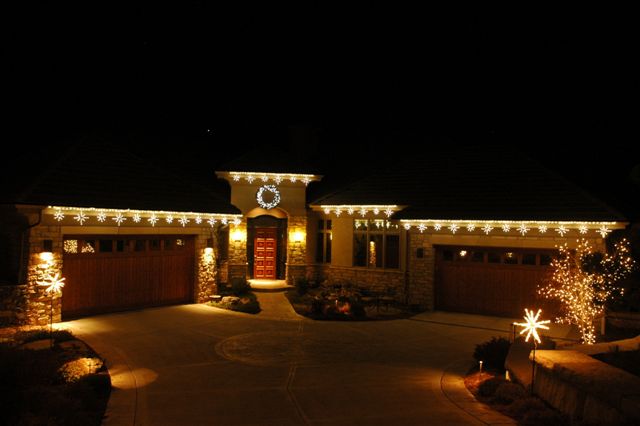
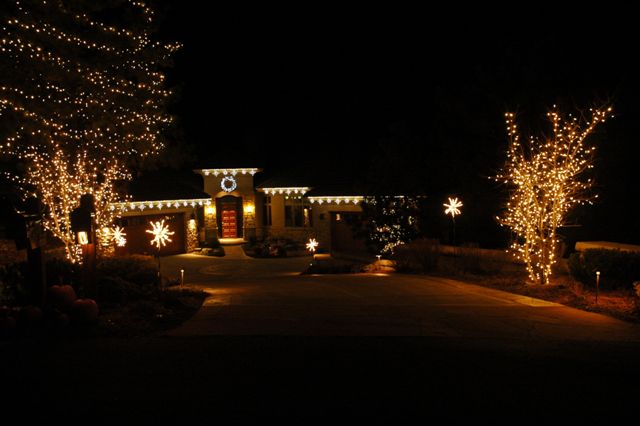
This concept is similar to our company’s concept of providing evening lighting demonstrations for our landscape and architectural lighting projects. This eliminates any guesswork and the customer actually gets to see what the lighting would look like prior to making a decision.  An example of what the actual Christmas lighting installation (in Castle Pines Village) looks like, can be seen below.

Enjoy the wonderful holiday season!

Christmas Lighting Installation in Castle Pines Village
Another View – Christmas Lighting in Castle Pines Village


Custom Low Voltage BBQ Light

Custom BBQ Light

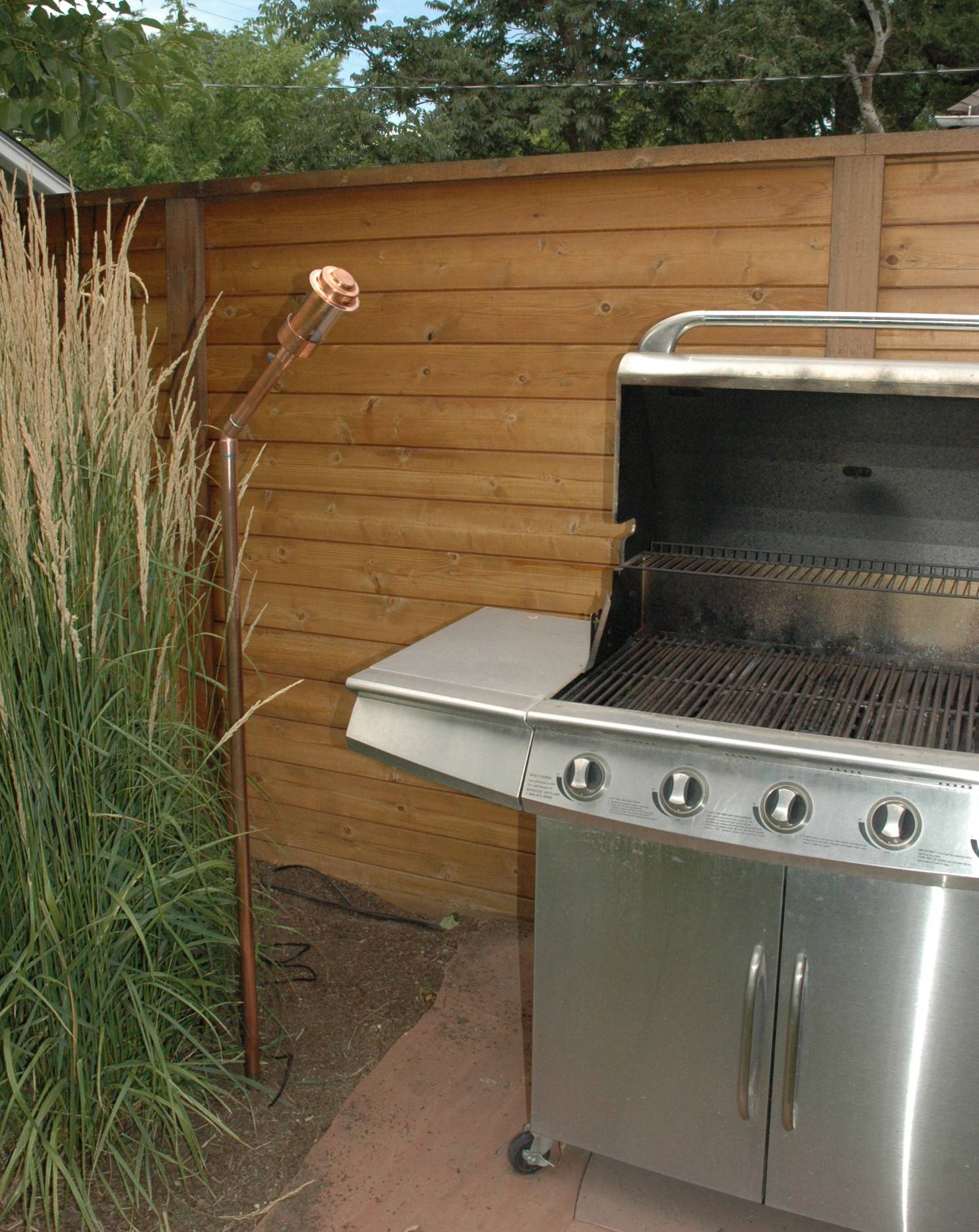
One of the advantages of being part of a large national/international lighting company is our ability to craft and install custom low voltage landscape/architectural lighting fixtures for our clients when the need arises. Last week we did a project for a customer who asked during the installation if there was a way to illuminate his barbecue grill. The customer wanted the ability to turn the BBQ light on and off separately from the rest of the landscape lighting system. The other requirement was that the customer did not want the lighting fixture attached in any way to the fence.

Our factory manufactures the copper BBQ lighting fixture assemblies with the black rubber all-weather switch and bulb socket assemblies. Our crew modified the assembly by installing a slightly larger copper flood head and mounting it at a 45-degree angle. By using an additional length of copper as well as one of our company’s heavy-duty underground PVC anchoring stakes, we were able to install the entire assembly behind some ornamental grasses.

The copper once it develops a patina will blend in nicely with the surrounding vegetation and fencing. The design and installation of this BBQ lighting fixture pretty much summarizes the goal of Outdoor Lighting Perspectives – and that is to emphasize the overall lighting effect with functional, unobtrusive, and durable lighting fixtures.

Custom Lighting Fixture Next to BBQ

Runway Lighting is for Airplanes

Solar Runway Lights for Cars?

One of the worst lighting design mistakes is the creation of runway lighting by lining each side of a driveway or walkway with lights. Some neighborhoods give the appearance that the homeowners are leaving the lights on for the return of Amelia Earhart!

The other evening I was walking Cody the Airedale and snapped these photos with my camera phone. It’s bad enough doing runway lighting with low voltage or line voltage lighting fixtures. It’s even worse when some of the current inexpensive and low-powered solar lights are used. In the photo above, the fixtures are literally two feet apart. We totally love the use of solar photovoltaic/LED lighting when it’s done properly – but these inefficient standalone solar lights are ripping off the unsuspecting homeowner.

Solar Lights Used on a Patio

One the right is a photo of a patio being under-illuminated by standalone solar lights. There’s a fairly large dropoff from the patio down to the lawn – so you can see that these lights will not provide the proper illumination for preventing falls especially if there’s a party.

The photo below illustrates the proper way to illuminate a walkway. As you can see, the path lights alternate from side to side along the walkway. The other thing you’ll notice with this design is that other lighting effects are used as well. Uplighting is used to illuminate the columns of the pergola as well as the trees. This keeps the lighting effect appearing fresh and interesting and not monotonous – the way it would look if you just did path lighting.

Proper Use of Path Lights along Walkway

Landscape Lighting, Foxes and Bears! Oh My!

Mama bear at outdoor lighting installation

As an outdoor lighting contractor in Colorado, we’re truly blessed to be able to see some of the most beautiful locations  and wild animals in the country. Our latest installation was no exception. Located at one of the highest residential sites on Cheyenne Mountain (yes that Cheyenne Mountain that is the home to NORAD), we just completed the back yard landscape lighting installation this past week. We first met mama bear and baby bear last summer when we completed the outdoor lighting system in the front yard.

Mama bear and baby bear at outdoor lighting installation

The site has a magnificent view of Colorado Springs below and the great plains beyond. During the day you can hear the carillon playing from the Will Rogers shrine and in the evening at 10:00 pm you can even hear taps being played from the Fort Carson army base. When we’re there in the evening to aim lights, we typically see the family of foxes.
We installed 30 lighting fixtures in the back yard to illuminate a patio, paths, and a beautiful water feature. In the front yard we installed 23 lighting fixtures to highlight the paths, trees, and rock outcroppings.
It’s definitely a pleasure living in Colorado!

New Commercial Website Is Live

In the early ’90s, Outdoor Lighting Perspectives (OLP) revolutionized the design, delivery/installation, and maintenance of residential landscape/architectural lighting. Almost all landscape lighting prior to that time was installed by electricians or by do-it-yourselfers with basic lighting kits – and the fixtures and low voltage transformers were purchased through local electrical/lighting supply houses/distributors. It was not uncommon under this scenario to have to wait 2 to 5 weeks for the distributor to order and obtain the products from the lighting manufacturer. OLP’s vertical integration with its local franchisees and factory decreased this turnaround time to a couple of days.

OLP is doing the same thing with its Commercial Lighting Division with the launch of its new commercial lighting website. Standard products can literally take only days to obtain (slightly longer for custom powder-coated versions). Just as is the case with all of our lighting designs and installations on the residential side, the emphasis on commercial lighting is also with quality design and lighting effect. OLP offers a complete turnkey operation – from design, installation, and on-going service.

OLP’s commercial lighting division emphasizes the latest in green-energy technology from low voltage quartz halogen/LED to line voltage Ceramic Metal Halide and Induction Fluorescents. In other words, we use just the right wattage bulb to do the job – but not one watt more than we need to!

To read the full press release from PR Web click here.

Mead’s Article – Outdoor Lighting Makes a Statement for a Community – Published

Hi – it’s Cathy here. I just wanted to let you know that Mead’s article – Outdoor Lighting Makes a Statement for a Community was published in the December 2009 issue of Common Interests – a publication by the Rocky Mountain Chapter of the Community Associations Institute. Mead’s article in its entirety follows.


Outdoor Lighting Makes a Statement for a Community

Mead L. Noss, P.E.

Owner, Outdoor Lighting Perspectives of Colorado


Communities take great pride in the aesthetics of their public spaces and landscaped areas during the daytime, and in the evening a community’s outdoor lighting should also set the appropriate tone. Does the community seem warm and inviting (safe and secure)? Or does the lighting detract from the overall experience of the neighborhood? Are the residents enjoying the public spaces after dark with well-illuminated path and bikeways?

More often than not, outdoor lighting in communities can be improved greatly with modern bulb technology, fixtures, and more effective lighting design. How many times have you driven by a community entrance with beautifully landscaped flower beds in the daytime only to be aghast at the same location in the evening as the once-beautiful landscaping is now bathed in the harsh yellow light from high-pressure sodium floods? In the current economic times with increasing energy costs and reduced operating budgets, communities now have the option of enhancing their outdoor lighting without sacrificing safety, security, aesthetics, usability, or energy efficiency.

Safety and Security

With any outdoor lighting system, safety and security are paramount. A good community lighting plan begins at all of the entrances to the community. You certainly want homeowners and their guests to find the community easily after dark but more importantly you want emergency fire, police and medical crews to find their way there even more quickly.

Well-placed and directed lighting will enhance the view of security cameras at an entrance gate or community center. Additionally, the security and accessibility of community mailboxes will be enhanced with overhead lighting.

Clubhouses, parks and other public areas must be properly illuminated to prevent falls and injuries after dark, as well as to deter vandalism and other crimes. Street lighting especially at intersections throughout the community enables motorists to find street signs after dark and to allow pedestrians to safely enjoy their evening walks.

The security of individual homeowners’ houses is also improved by architectural and landscape lighting that illuminates both the home and the perimeter of the property. Any police department in the state or country will tell you that burglars will almost always target the homes without lighting rather than taking risks with homes that are well-illuminated.

One of the myths about security and outdoor lighting is that if a little lighting is good, adding much more lighting is better – right? Well, that’s not actually the case. If the lighting fixtures produce lots of glare, adding additional fixtures of the same type or increasing the wattage of the bulbs will actually produce more glare thereby reducing visibility and security. A truism of good lighting design is that the quality of light is always better than the quantity of light.

Aesthetics and Usability

The aesthetics and usability of the overall lighting found in a community is of the utmost importance. The impression of the community after dark should be warm and inviting without harsh lights or glare. How often have you driven into a community only to be blinded by unshielded carriage lights at the entrance or by unshielded carriage lights along the street on driveway columns?

There are two types of glare – nuisance glare and disabling glare – and carriage lights along the street really do approach the level of disabling glare, especially for older drivers. As we age, our eyes become more susceptible to the effects of glare and it takes us longer to recover our full vision.  

Misdirected flood lights from one neighbor’s house into the adjacent neighbor’s yard (called light trespass) is unpleasant and can be categorized as nuisance glare – and it certainly affects the usability and enjoyment of the affected neighbor’s yard or his/her night’s sleep if the lighting is visible from their bedroom.

Any time that a bulb source is visible to anyone living in or driving through a community, it means that the lighting and resulting energy costs are wasted because the lighting is not directed to only where it’s needed.

Energy Efficiency and Cost

One of the first rules of lighting design is to not specify more light than you need; i.e., do not use line voltage metal halide lighting fixtures where low-voltage quartz halogen or LED (light-emitting diode) fixtures might do. It all depends on the ambient lighting conditions, what needs to be illuminated, and how the space is to be used in the evening. Evening lighting demonstrations with different lighting and cost options can provide communities with meaningful and visual comparisons from which to base their future capital improvement decisions.

Recent technology has improved to the extent that lighting designers and contractors can now provide energy efficient lighting that is effective from both a lumen output and Color Rendering Index (CRI) standpoint. What exactly is CRI? CRI is the comparison of how well a particular light source emits a color approximating a noon time sun (See the following table).

COLOR RENDERING INDEX TABLE

LIGHT SOURCE CRI
Noon Day Sun 100
Great Color (color matching above 97)   95+
Good Color   80 – 94
Poor Color (where colors do not show)   79
Fluorescent and Induction Fluorescent   50 – 98
LED   70 – 80 (getting better)
High Pressure Sodium   50
Quartz Halogen   80 – 92
Metal Halide   80+
Ceramic Metal Halide   90 – 96


Ceramic Metal Halide bulbs (39W or 70W) with a 15,000-hour life powered by low-voltage or line-voltage systems provide the true color (90-96 CRI) that is desired for lighting entrances, parks, and clubhouses in the evening.

Quality low-voltage LED (light emitting diode) fixtures with 50,000-hour rated life bulbs have recently become available and with an acceptable and improving CRI. The tradeoff investment-wise is a higher initial cost with lower residual operating costs.

When comparing bulb sources and efficiency, another helpful term is the lumen. A lumen is the measurement of reflectant light off of a surface. This is how all light sources are rated as you can see in the following table:

LUMEN COMPARISON BY LIGHT SOURCE

LIGHT SOURCE LUMENS/WATT
Incandescent   8
Quartz Halogen  15 – 19
Mercury  30 – 40
LED  30 – 80
Fluorescent  40 – 80
Metal Halide  80 – 110
Induction Fluorescent  80
Ceramic Metal Halide  80 – 110
High Pressure Sodium 120


As you can see from the table, incandescent bulbs are very inefficient and high pressure sodium bulbs are very efficient, as long as you like everything looking yellow in the evening. With respect to energy efficiency and light quality, line voltage or low voltage ceramic metal halide and low voltage quartz halogen lighting systems are the best solution, with low-voltage LED lighting systems becoming more and more acceptable for certain applications. In fact, LED lighting installations powered by off-the-grid solar photovoltaic systems are the optimum solution for community areas requiring lighting but having no readily available source of power.

Maintenance

Warranties and maintenance costs become very important over the long term with respect to lighting systems – and communities and their respective homeowners should try to obtain the best warranties available. In addition, the best maintenance for any lighting system is usually provided by the original company that installed it since they are most familiar with the product and installation. However, not all companies that install lighting systems also provide maintenance so that is an important consideration when evaluating a contractor.

As with any other asset in the community, lighting systems need to be maintained on a regular basis to provide optimum performance and to serve the needs of the community. In closing, the appearance of any outdoor lighting system (daytime or evening) really does set an appropriate tone for the community.

Sources:

  1. Go Green, Save Green presentation, Outdoor Lighting Perspectives Commercial Lighting Division, 2008.
  2. Illuminating Engineering Society

Complimentary Nighttime Lighting Design in Colorado

ask_for_preview


Most people do not know it’s possible to have a free lighting design preview for their home, business or community entrance/park/clubhouse, etc. While it is possible to lay out a preliminary design on paper, there is absolutely no substitute for conducting an evening lighting design demonstration to ensure that the desired lighting effect is achieved.

A lot of people mistakenly believe that the first step in  lighting design is to select the fixtures. Until you know what you want to illuminate and what bulb and wattage you need for the desired lighting effect, the last thing you want to do is select the wrong fixture for the intended application. Unfortunately, this happens all of the time. We get calls almost every week from homeowners who are unhappy with their lighting system – and they are quick to add that they had no idea what the lighting would look like until AFTER the installation. We always tell them not to feel too badly because their contractor had no idea either.

With our national company, we always like to say that we’re not in the business of selling fixtures, we’re in the business of selling lighting effect. Unlike most of our competitors, we do not just point and recommend where the fixtures should go – we set them up so that you can judge for yourself whether we have achieved the lighting effect that meets your needs.

Even seasoned building architects and landscape architects are surprised by the different possibilities of lighting effects – especially when they can see them prior to the final installation. To give you a case in point, I once received a call from a nationally known commercial landscape architect who needed path lighting for his home’s front sidewalk.

He told me difinitively that he needed five path lights. When I asked him what neighborhood he lived in, I knew that the house setbacks were not excessively far from the street and suggested that he could probably get by with only three path lights. No, he replied, stating that this is what I do for a living. When we did the evening lighting demonstration, the commercial landscape architect was incredulous that he only needed a total of three path lights. Interestingly, landscape architecture programs throughout the U.S. typically require only ONE three credit course in landscape lighting – and it’s rare that students actually get to see an evening lighting design demonstration during this course.

Depending on the ambient lighting conditions and lighting needs of a customer, we may actually set up either low voltage (quartz halogen or LED) fixtures or line voltage fixtures (Ceramic Metal Halide). If we’re trying to illuminate a large commercial building that is located next to a busy street with sodium street lights for example, we know that a low voltage lighting system will not provide the intended lighting effect next to these bright sodium street lights.

For any evening lighting design demonstration, we always sit down with the home or business owner to determine what their primary lighting needs are. For example, are they primarily interested in safety and security or are they more interested in highlighting the unique architectural features of their house/business and/or expanding their usable living space in the evening? Sometimes the answer is all of the above. Until you have an answer to this question, you cannot possibly know how to even begin a lighting design.

By seeing a lighting design laid out with a temporary lighting system, you will know exactly what you will be getting if you decide to proceed with an installation – no guessing and no surprises. Any changes to this preliminary design are easily made as a home/business owner adjusts the system to their particular tastes.

Once the desired lighting effect is achieved, flags can be put in place to accurately mark the position of each and every fixture. By that point in the demonstration, you will have seen that in a lot of cases moving a fixture a couple of feet one way or the other can make a huge difference in the lighting effect.

Another key point is that not all fixtures and installations are created equally. The customer needs to be confident that a lighting installation will look as good ten years from now as it looks today.

A lot of our friends and business associates marvel at our late-night design demonstrations and ask – isn’t that a lot of work? Our answer is always no because this is what we do to ensure that our customers are 100% satisfied with their lighting systems. And it’s always easier to do something the right way the first time.

Our hope is that home and business owners will find these complimentary nighttime lighting designs in Colorado educational, enjoyable and useful. A quality lighting system can add value to a home or business, and we believe that you the one best suited to make this decision for yourself.

LC 7 Bollard Night Park