Mead’s Article – Outdoor Lighting Makes a Statement for a Community – Published

Hi – it’s Cathy here. I just wanted to let you know that Mead’s article – Outdoor Lighting Makes a Statement for a Community was published in the December 2009 issue of Common Interests – a publication by the Rocky Mountain Chapter of the Community Associations Institute. Mead’s article in its entirety follows.


Outdoor Lighting Makes a Statement for a Community

Mead L. Noss, P.E.

Owner, Outdoor Lighting Perspectives of Colorado


Communities take great pride in the aesthetics of their public spaces and landscaped areas during the daytime, and in the evening a community’s outdoor lighting should also set the appropriate tone. Does the community seem warm and inviting (safe and secure)? Or does the lighting detract from the overall experience of the neighborhood? Are the residents enjoying the public spaces after dark with well-illuminated path and bikeways?

More often than not, outdoor lighting in communities can be improved greatly with modern bulb technology, fixtures, and more effective lighting design. How many times have you driven by a community entrance with beautifully landscaped flower beds in the daytime only to be aghast at the same location in the evening as the once-beautiful landscaping is now bathed in the harsh yellow light from high-pressure sodium floods? In the current economic times with increasing energy costs and reduced operating budgets, communities now have the option of enhancing their outdoor lighting without sacrificing safety, security, aesthetics, usability, or energy efficiency.

Safety and Security

With any outdoor lighting system, safety and security are paramount. A good community lighting plan begins at all of the entrances to the community. You certainly want homeowners and their guests to find the community easily after dark but more importantly you want emergency fire, police and medical crews to find their way there even more quickly.

Well-placed and directed lighting will enhance the view of security cameras at an entrance gate or community center. Additionally, the security and accessibility of community mailboxes will be enhanced with overhead lighting.

Clubhouses, parks and other public areas must be properly illuminated to prevent falls and injuries after dark, as well as to deter vandalism and other crimes. Street lighting especially at intersections throughout the community enables motorists to find street signs after dark and to allow pedestrians to safely enjoy their evening walks.

The security of individual homeowners’ houses is also improved by architectural and landscape lighting that illuminates both the home and the perimeter of the property. Any police department in the state or country will tell you that burglars will almost always target the homes without lighting rather than taking risks with homes that are well-illuminated.

One of the myths about security and outdoor lighting is that if a little lighting is good, adding much more lighting is better – right? Well, that’s not actually the case. If the lighting fixtures produce lots of glare, adding additional fixtures of the same type or increasing the wattage of the bulbs will actually produce more glare thereby reducing visibility and security. A truism of good lighting design is that the quality of light is always better than the quantity of light.

Aesthetics and Usability

The aesthetics and usability of the overall lighting found in a community is of the utmost importance. The impression of the community after dark should be warm and inviting without harsh lights or glare. How often have you driven into a community only to be blinded by unshielded carriage lights at the entrance or by unshielded carriage lights along the street on driveway columns?

There are two types of glare – nuisance glare and disabling glare – and carriage lights along the street really do approach the level of disabling glare, especially for older drivers. As we age, our eyes become more susceptible to the effects of glare and it takes us longer to recover our full vision.  

Misdirected flood lights from one neighbor’s house into the adjacent neighbor’s yard (called light trespass) is unpleasant and can be categorized as nuisance glare – and it certainly affects the usability and enjoyment of the affected neighbor’s yard or his/her night’s sleep if the lighting is visible from their bedroom.

Any time that a bulb source is visible to anyone living in or driving through a community, it means that the lighting and resulting energy costs are wasted because the lighting is not directed to only where it’s needed.

Energy Efficiency and Cost

One of the first rules of lighting design is to not specify more light than you need; i.e., do not use line voltage metal halide lighting fixtures where low-voltage quartz halogen or LED (light-emitting diode) fixtures might do. It all depends on the ambient lighting conditions, what needs to be illuminated, and how the space is to be used in the evening. Evening lighting demonstrations with different lighting and cost options can provide communities with meaningful and visual comparisons from which to base their future capital improvement decisions.

Recent technology has improved to the extent that lighting designers and contractors can now provide energy efficient lighting that is effective from both a lumen output and Color Rendering Index (CRI) standpoint. What exactly is CRI? CRI is the comparison of how well a particular light source emits a color approximating a noon time sun (See the following table).

COLOR RENDERING INDEX TABLE

LIGHT SOURCE CRI
Noon Day Sun 100
Great Color (color matching above 97)   95+
Good Color   80 – 94
Poor Color (where colors do not show)   79
Fluorescent and Induction Fluorescent   50 – 98
LED   70 – 80 (getting better)
High Pressure Sodium   50
Quartz Halogen   80 – 92
Metal Halide   80+
Ceramic Metal Halide   90 – 96


Ceramic Metal Halide bulbs (39W or 70W) with a 15,000-hour life powered by low-voltage or line-voltage systems provide the true color (90-96 CRI) that is desired for lighting entrances, parks, and clubhouses in the evening.

Quality low-voltage LED (light emitting diode) fixtures with 50,000-hour rated life bulbs have recently become available and with an acceptable and improving CRI. The tradeoff investment-wise is a higher initial cost with lower residual operating costs.

When comparing bulb sources and efficiency, another helpful term is the lumen. A lumen is the measurement of reflectant light off of a surface. This is how all light sources are rated as you can see in the following table:

LUMEN COMPARISON BY LIGHT SOURCE

LIGHT SOURCE LUMENS/WATT
Incandescent   8
Quartz Halogen  15 – 19
Mercury  30 – 40
LED  30 – 80
Fluorescent  40 – 80
Metal Halide  80 – 110
Induction Fluorescent  80
Ceramic Metal Halide  80 – 110
High Pressure Sodium 120


As you can see from the table, incandescent bulbs are very inefficient and high pressure sodium bulbs are very efficient, as long as you like everything looking yellow in the evening. With respect to energy efficiency and light quality, line voltage or low voltage ceramic metal halide and low voltage quartz halogen lighting systems are the best solution, with low-voltage LED lighting systems becoming more and more acceptable for certain applications. In fact, LED lighting installations powered by off-the-grid solar photovoltaic systems are the optimum solution for community areas requiring lighting but having no readily available source of power.

Maintenance

Warranties and maintenance costs become very important over the long term with respect to lighting systems – and communities and their respective homeowners should try to obtain the best warranties available. In addition, the best maintenance for any lighting system is usually provided by the original company that installed it since they are most familiar with the product and installation. However, not all companies that install lighting systems also provide maintenance so that is an important consideration when evaluating a contractor.

As with any other asset in the community, lighting systems need to be maintained on a regular basis to provide optimum performance and to serve the needs of the community. In closing, the appearance of any outdoor lighting system (daytime or evening) really does set an appropriate tone for the community.

Sources:

  1. Go Green, Save Green presentation, Outdoor Lighting Perspectives Commercial Lighting Division, 2008.
  2. Illuminating Engineering Society

Solar Photovoltaic/LED Dark-Sky Compliant Entrance Lighting

Continuing our theme of highlights for 2009, the most interesting project was our solar photovoltaic lighting installation for the Village of Genesee. We had received a request from the Villages’s property management firm to provide lighting at two entrances – one with power and one without power. The site without power therefore would require the installation of an off-grid solar photovoltaic lighting system.

Site without Power

Both sites required that the fixtures be dark-sky compliant; i.e., the fixtures must point downward so as to not discharge any light into the night sky. In addition, both installations had to withstand the extra wear and tear of heavy snowstorms, the excessive mountain winds, and last but not least, the large herd of elk.

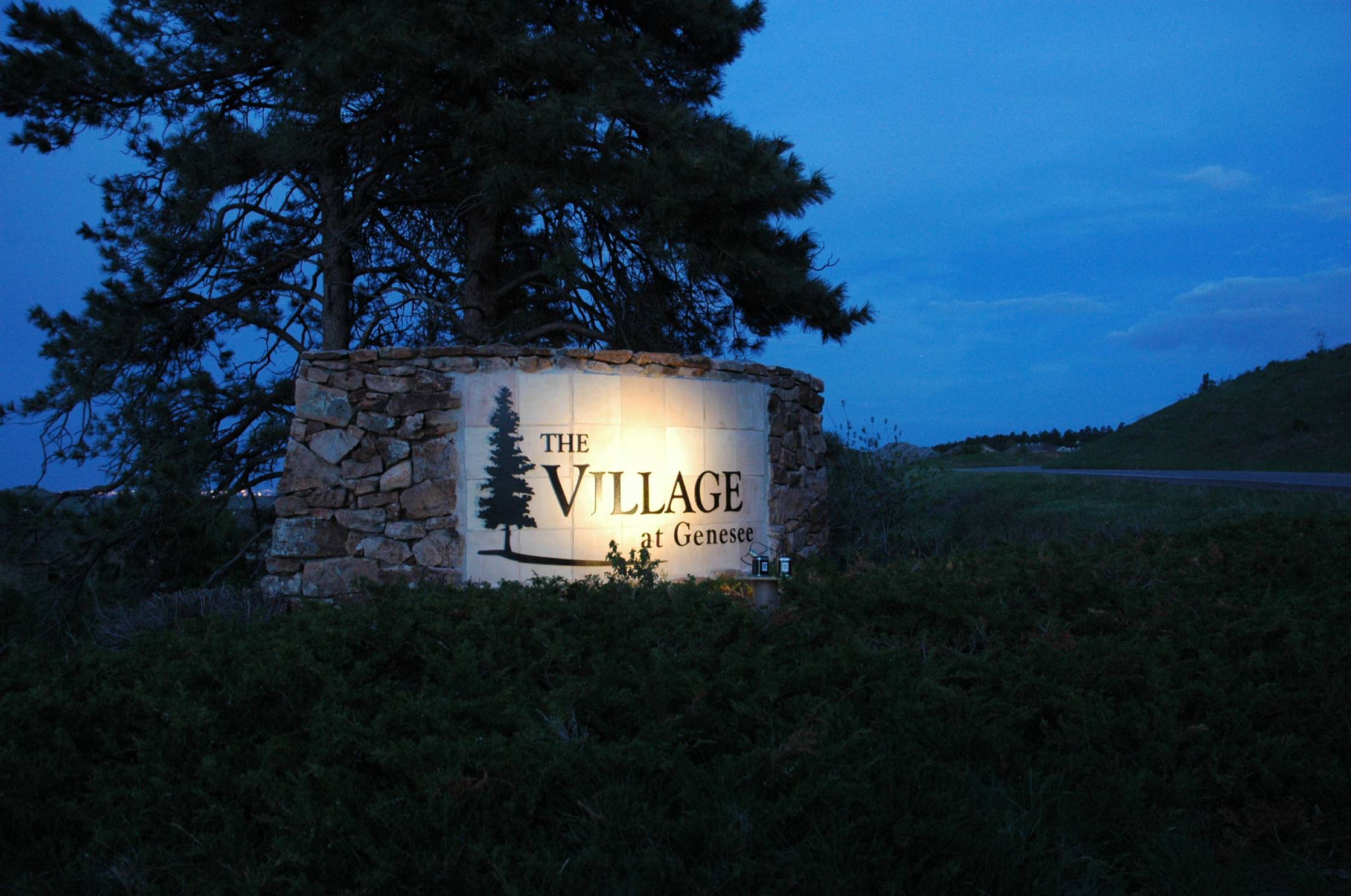
What made this installation feasible was the introduction of the next generation LED (light emitting diode) fixture that draws only 3.7 watts. Our manufacturing partner is now providing us with very high-quality LED lighting fixtures with excellent color and lighting effect. By changing the lens optics, we could vary the lighting effect to create just the right lighting for the monument signage. A photo taken during the actual evening demonstration is shown below.

Evening LED Demo

On the solar photovoltaic (PV) side, the technology in terms of cost and quality has also improved significantly over the last few years. Coupled with the advances of the LED lighting technology, a high quality, long lasting solar PV/LED installation was now a reality.

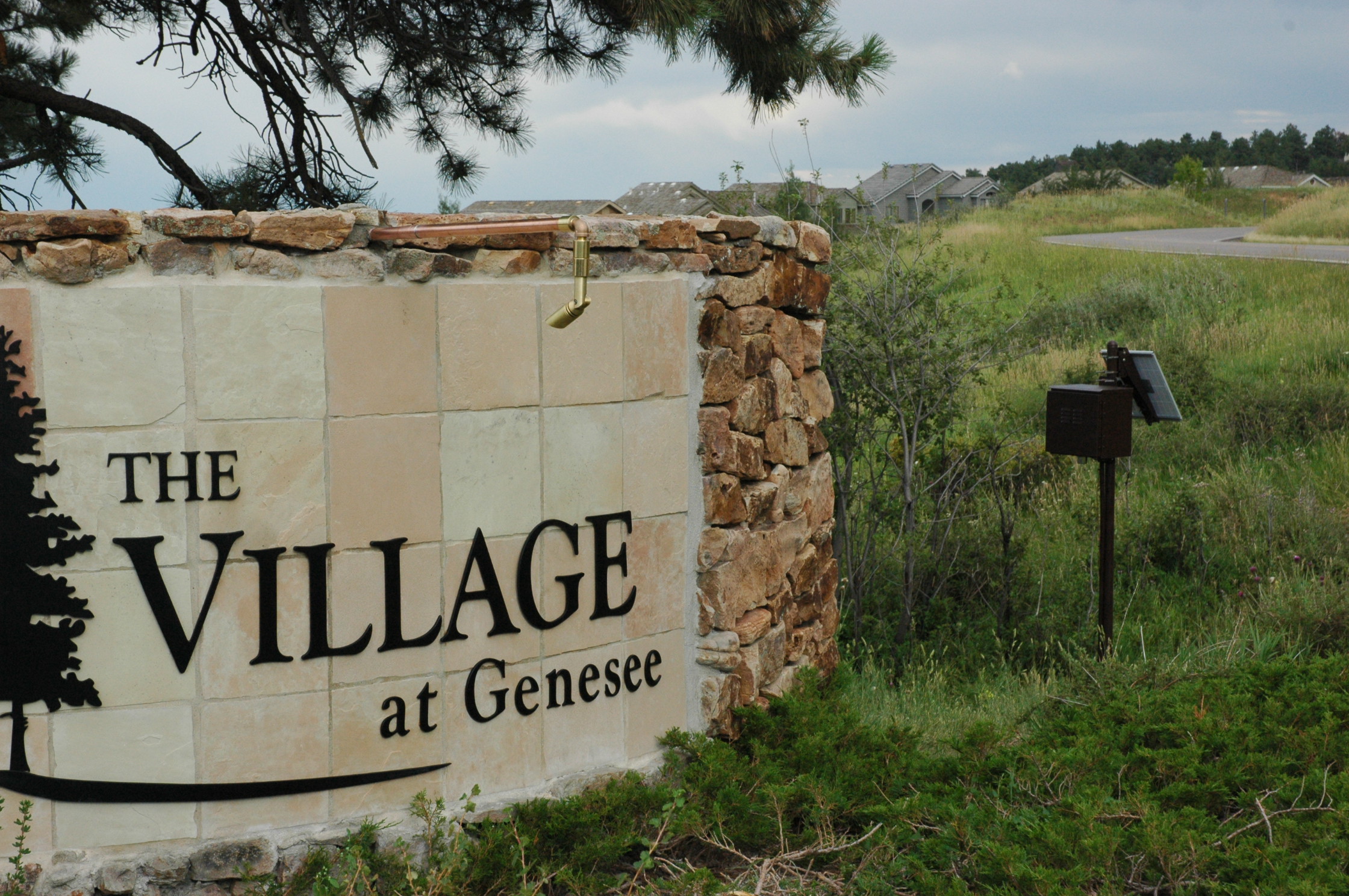
A 20W solar PV panel was installed along with a solar gel battery that would provide at least five days of stored power for the system – enough to outlast long periods of clouds and snow during the winter months.

The battery, the controller (the brains of the system), and the lighting surge suppression system were installed in the aluminum equipment bay which was itself installed at the top of a structural aluminum pole. A photo of the completed installation is shown below.

Completed Installation with Solar PV Mast in Background

Interestingly, the solar PV panel has been blocked by snow only once this season. Prior to last Halloween, the foothills received 37-inches of snow and the HOA president had to brush off the panel with a broom with an extension handle.

In addition, the LED lighting installation at the second site that already had power was completed – and that installation is shown below. For this installation, two box floods each having 35-watt high pressure sodium bulbs were replaced by the two 3.7-watt LED lighting fixtures. The monthly electric bill for the HOA at this entrance dropped from $80.00 to $11.00!

LED Lighting Installation with Power

CHANNELBRITE PERMANENT LED – 2009 HOT PRODUCT!


9NEWS HOT PRODUCT AWARD CHANNELBRITE

As we continue to look back at the highlights of 2009, one of the most memorable was OLP of Colorado’s selection as a 9NEWS HOT PRODUCTS ZONE AWARDEE at the Colorado Garden and Home Show for its permanent LED lighting product – ChannelBrite™. Only nine companies (Hot Products) were selected from over 650 companies exhibiting at the show. 

The Hot Products Awardees receive special exposure along with a separate high visibility exhibit in the lobby of the Colorado Convention Center as well as a special live interview segment on 9NEWS prior to the opening of the show. 

Hot Products Zone 2009


Closeup of Channelbrite Exhibit


ChannelBrite is a permanent LED solution for both residential holiday lighting as well as year-round commercial applications where business owners want to have their businesses stand out from the competition. The LEDs are rated for 100,000 hours of service. In fact, if you used them 10 hours a day, that would translate into 25 years of service.
 
A program controller allows you to set the speed, pattern and colors of the light display. The ChannelBrite installation is virtually unnoticeable when not in use and it requires just 10-percent of the energy consumed by normal incandescent lighting.
 
For commercial applications, a more densely packed LED strip can replace the more inefficient fluorescent lights that are currently used to outline buildings. By using Channelbrite, business owners can call attention to their location in a unique, attractive and upscale way without any annoying light spillover into adjacent businesses or residences.
 
The ChannelBrite product is backed by a full 3-year warranty. The ChannelBrite display that was in our main exhibit is shown below:
 
 
OLP of Colorado Exhibit with ChannelBrite

The technology and energy efficiency of this new and amazing permanent LED product are truly astounding. And because ChannelBrite is installed on the structure itself and not below ground (as is the case with landscape lighting), it can be scheduled for installation at any time of year. 

Pictures of actual installations/applications follow. 


ChannelBrite Virtually Invisible in Daytime

Residential ChannelBrite - Candy-Cane Pattern

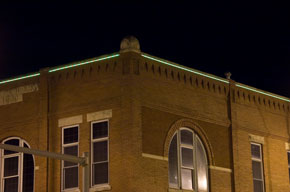
Municipal Building with ChannelBrite

COME SEE US AT THE COLORADO FALL HOME SHOW

     fall_cgs                                                                      Come visit us at the upcoming Colorado Fall Home Show – Booth #717 at the Colorado Convention Center in downtown Denver – September 19th and 20th. Saturday hours are from 10:00 AM through 8:00 PM and Sunday hours are from 10:00 AM to 5:00 PM.

This Fall Show – Denver’s only fall home show – will feature almost 300 companies with a focus on home renovation, remodeling, and sustainable living. The show also features two demonstration theaters offering educational seminars provided by experts in sustainability, energy efficiency, interior design, remodeling and cooking.

Outdoor Lighting Perspectives of Colorado will be displaying and launching its newest low-voltage LED landscape/architectural lighting fixtures and products. These are the first LED products that meet OLP’s hgh standards for quality lighting effect as well as durability.

In addition, permanent and more traditional LED holiday lighting products will be on display, as well as a new truly unique LED ribbon lighting product that is the only UL-approved LED ribbon available today that is suitable for a wet location.

Of course, our standard low voltage quartz halogen fixtures, ceramic metal halide commercial fixtures, and Lighting Control Automation™ will also be on display for your review and/or questions. We hope to see you there!

Mead and Cathy Noss

GO GREEN SAVE GREEN SIGN

Mead Completes Green Homes Certificate Program

In May, Mead Noss (owner of Outdoor Lighting Perspectives of Colorado), completed the 13-week long Green Homes Certificate Program at the Colorado State University (CSU) Denver campus.

 CSU

The program is conducted by CSU’s Institute for the Built Environment and focusses on residential building strategies and tools, including the major rating systems – LEED-Homes®, Built Green, and ENERGY STAR. CSU is the Rocky Mountain region’s leading university in green design and construction management education. The certificate program coursework focussed on the following topics in green residential building, new construction and remodeling:

  • Residential green building in Colorado
  • Site and home design – first steps toward a green home
  • Energy efficient envelope – the backbone of a green home
  • High performance HVAC systems for new, remodeled and existing homes
  • Indoor environmental quality
  • Field trip: home performance testing demonstrations; green homes visits
  • Sustainable and healthy building and finish materials/products
  • Natural home building techniques
  • Design charrette
  • Construction waste recycling, deconstruction, remodeling
  • Green rating systems: LEED®-Homes; Built Green, Energy Star

Of primary interest to Mead and Outdoor Lighting Perspectives of Colorado, are the new energy-efficient lighting technologies (LED (light-emitting diode), CFL – compact fluorescents) as well as off-grid power options including solar photovoltaics and wind turbine energy.

Mead said that Colorado is at the epicenter of alternative energy research and implementation in the country. The information and contacts that I’ve made through this progam will help to position OLP of Colorado to take advantage of this new technology – and to provide our current and future customers these green lighting options.

CELEBRATE EARTH HOUR TODAY

voteearth_enEarth Hour is being sponsored by the World Wildlife Fund to bring attention to the growing problem of global warming and its adverse effects on the planet. Even though we’re a lighting company, we urge you to show your support and make a statement by turning off your non-essential indoor and outdoor lights between the hours of 8:30 PM to 9:30 PM. This will help decrease your carbon footprint slightly but more importantly it will show your symbolic support for this global iniative.

In downtown Denver, the State Capitol, the Denver City and County building, and several skyscrapers will go dark during this time. Over 4,000 cities worldwide are participating this year. By comparison, only 400 cities were involved last year. From the pyramids in Egypt to the Eiffel Tower in Paris to the Harbor Bridge in Sydney, all of these well-known structures will have their outdoor lighting dim or be turned off completely during this period.

As an outoor lighting contractor, we are already committed to energy efficiency and conservation. The good news is that outdoor lighting and landscape lighting we install for residential applications is either low-voltage quartz halogen (12-volts) or low-voltage LED (light-emitting diode). On commercial applications where line voltage (120-volts) is required because of loads and distances, we still employ very energy-efficient 39W to 70W ceramic metal halide bulbs.  So what makes our lighting systems green? Please read the following:

Low Voltage Lighting. Every outdoor lighting system we install is low voltage rather than line voltage. Our outdoor lighting system transformers are designed to reduce the standard 120-volt line voltage used throughout homes to low voltage 12-volt electricity, which powers our outdoor lighting systems. In otherwords, 12 volts of power run from the low voltage transformer through the wire to the low-wattage bulbs mounted in the lighting fixtures. Our lighting systems provide energy efficiency while illuminating your home and property with soft, ambient accent lighting. In addition, our professionally designed low voltage lighting systems are precisely bright enough to illuminate a home’s exterior and landscaping, at a cost about 50- to 60-percent less to operate than with a standard 120-volt outdoor lighting system. To further enhance energy conservation, our low voltage lighting fixtures are strategically placed to highlight the key features of the architecture or landscaping, so that the light is not “wasted” by just flooding an entire area. And sometimes if not done properly, the light can spill into a neighbor’s yard and this is called light trespass.

Low voltage LEDs can save even more energy than low voltage quartz halogen systems but the initial investment cost is much higher. We’ll have information about our LED lighting systems in a future blog.

Heavier-Gauge Wire. The heavier the gauge of wire used in electrical systems, the less energy is lost as current travels through it. We use 12-, 10-, and 8-gauge wire in our lighting systems, with the 12-gauge wire being used primarily in residential installations. Also, voltage loss increases as more fixtures (or higher loads) are connected to a single wire run. To prevent this, we construct our systems with multiple wire runs and multitap transformers with output voltages ranging between 12-volts and 22-volts.

Choice of Lamps (Bulbs). Rather than incandescent bulbs, we use low-voltage quartz halogen bulbs (4,000 hour life), low-voltage LED (50,000 hour life), or line voltage CMH (ceramic metal halide – 15,000 hour life bulbs for commercial applications). All of our bulbs also incorporate reflectors which help to brighten and focus the resulting light without having to use higher wattage bulbs.

Control Technology. Our company, Outdoor Lighting Perspectives of Colorado, recommends the use of control technology to automatically turn on and off necessary indoor and outdoor lighting on the interior and exterior of the house. The control system we use is Lighting Control Automation(TM) (LCA). With this system, the latitude and longitude of the house is programmed into the controller (and on a daily basis any time of year) the lights will come on at exactly astronomical sunset – not two hours before or an hour late. This system eliminates the energy wasted by the old-technology timer/photocell systems; invariably the photocell becomes shaded and the lights turn on too soon or the mechanical timer ends up being three hours out of synch because of power failures.

In addition, the LCA system can be used to automatically dim exterior architectural carriage lights, porch lights, soffit lights, and/or garage lights by 20- to 40- percent for additional energy savings. Interior lights can be integrated into this system as well for more energy savings. In addition to automatic control, any of these “intelligent” lights on the interior or exterior can be manually controlled from inside the house for even more energy savings.

So tonight, celebrate Earth Hour and if you already own a low voltage outdoor lighting system or a whole-house lighting control system, give yourself a pat on the back for helping to reduce your carbon footprint on the planet!

Best regards,

Mead Noss